
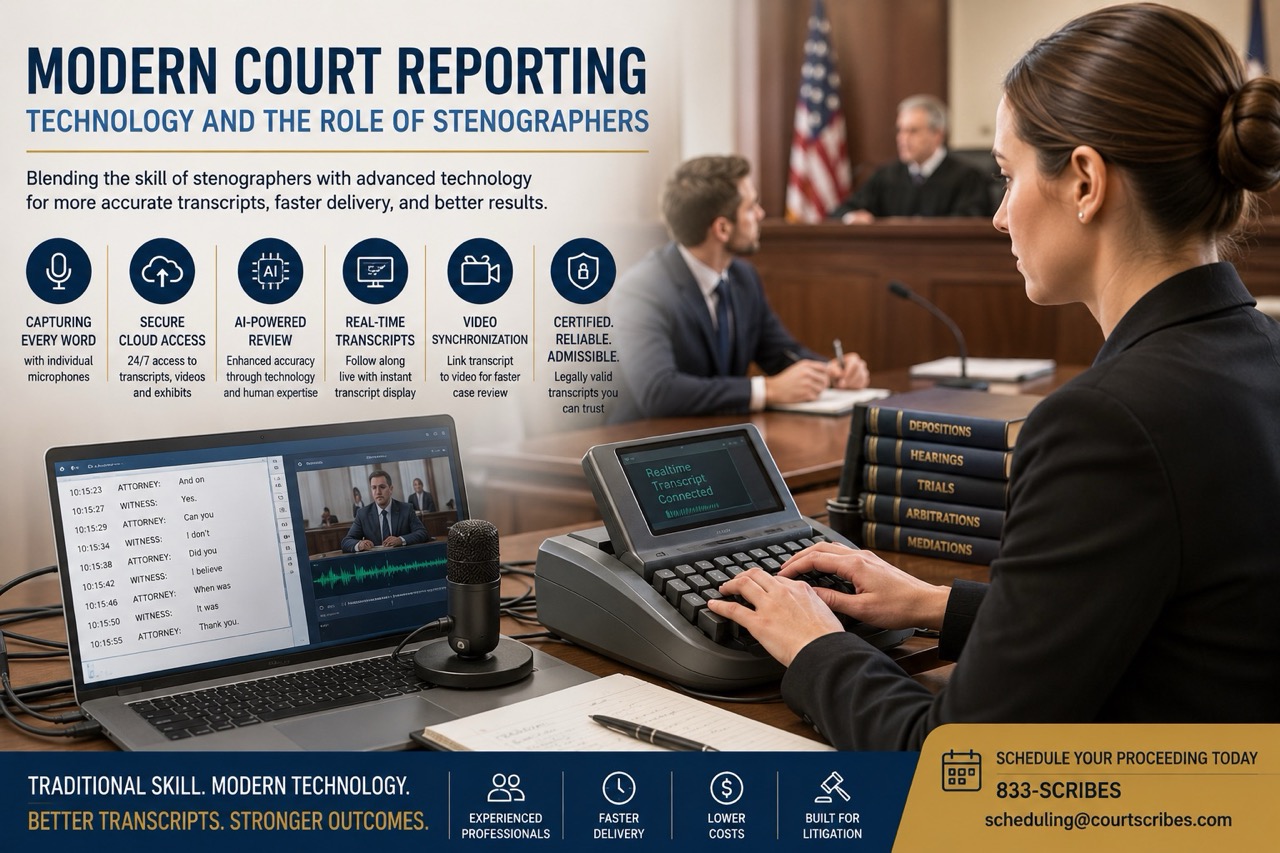
Modern Court Reporting Technology and the Role of Stenographers
Anyone who has attended a deposition, trial, arbitration, or administrative hearing has likely seen a court stenographer seated quietly beside the proceeding while testimony unfolds. From the outside, the role can appear straightforward, but court stenography is one of the most technically demanding professions within the legal system. A court stenographer must capture spoken testimony in real time while maintaining speed, accuracy, concentration, and legal formatting standards under constant pressure. Every objection, witness response, and procedural exchange may later become critical during motions, appeals, settlement discussions, or trial preparation.
At the same time, the profession continues evolving as modern legal technology changes how transcripts are created, reviewed, and delivered. At CourtScribes, we combine traditional reporting standards with modern digital court reporting systems that integrate human expertise, multi-channel audio recording, cloud-based access, AI-assisted review, and transcript verification tools. This approach helps legal professionals improve efficiency, strengthen transcript accuracy, and access organized records more easily throughout the litigation process. This page explains the traditional responsibilities of a court stenographer, how modern court reporting technology functions, and why more attorneys and legal teams now rely on technology-supported reporting solutions provided by CourtScribes.
The Traditional Role of a Court Stenographer
A court stenographer, also known as a court reporter or stenographic reporter, is a trained professional responsible for producing a verbatim written record of spoken proceedings. Their primary tool is a stenotype machine, a specialized keyboard with far fewer keys than a standard keyboard. Rather than typing one letter at a time, a stenographer types combinations of keys simultaneously, with each chord representing a syllable, a word, or a phrase.
At peak proficiency, a skilled court stenographer can capture speech at speeds exceeding 225 words per minute. That speed is what makes the role possible in live legal environments where multiple speakers may talk rapidly and without pause. After a proceeding concludes, the stenographer translates their machine shorthand into readable text, reviews it for accuracy, and certifies the final transcript as a true and verbatim record of what was said.
Beyond depositions and courtroom trials, a court stenographer may also work at arbitrations, mediations, legislative hearings, administrative proceedings, and closed captioning for broadcast television. The work requires extraordinary concentration, a deep familiarity with legal and medical terminology, and the ability to maintain accuracy under pressure for hours at a time.
The Limitations of Traditional Stenography
Traditional stenography reflects real skill, discipline, and legal experience. However, legal teams should also understand its practical limits. At CourtScribes, we respect certified stenographers while recognizing how modern reporting tools can improve accuracy, verification, cost control, and delivery speed.
- The first limitation is the acoustics problem. A court stenographer hears the proceeding the same way anyone else in the room does. When multiple speakers talk at once, when a witness mumbles, or when a courtroom environment is particularly loud or chaotic, the stenographer must make judgment calls about what was said. Those judgment calls introduce errors. And unlike a recording, there is no way to go back and verify what actually happened.
- The second limitation is cost. Certified stenographic court reporters are in high demand and relatively short supply. Shortages have been growing across the country for years, which drives up rates and sometimes makes it difficult to find a qualified court stenographer on short notice, particularly for proceedings in less populated areas or with tight scheduling windows.
- The third limitation is the speed of delivery. Traditional transcript delivery often depends on the individual reporter’s workload. Expedited turnaround costs more, sometimes significantly more. For legal teams that need same-day or next-day transcripts to stay competitive, this can be a serious logistical constraint.
None of this diminishes the skill and dedication that every certified court stenographer brings to their work. It simply reflects the structural limits of any method that depends entirely on one person’s real-time performance.
How Court Stenographers Work Across Different Legal Environments
The mental image most people carry of a court stenographer is someone perched at the corner of a courtroom near the witness stand. That picture is accurate for trial work, but it represents only one of the environments these professionals operate in. Depositions account for a large share of court stenography work.
A witness is sworn in, attorneys examine and cross-examine, and the stenographer captures every word in a conference room near a downtown law office, in a medical facility, or in a firm located blocks from the courthouse. The transcript produced from that session follows the case through discovery, settlement negotiations, trial preparation, and sometimes all the way to appeal.
A single missed word or miscaptured name in a deposition transcript can create real problems months later when the record is scrutinized under pressure. Stenographers also work in administrative hearings, workers’ compensation proceedings, insurance examinations under oath, and legislative sessions. Anywhere a verbatim record carries legal weight, stenographic transcription or an equivalent technology has traditionally been the solution.
Understanding the Skill Required for Real-Time Stenography
What makes court stenography technically demanding is not speed alone. It is the combination of speed, accuracy, and judgment under conditions that are rarely clean. Witnesses mumble. Attorneys talk over each other. Non-native English speakers use phrasing that requires careful interpretation. Proper nouns, medical terminology, and specialized legal vocabulary appear without warning, and the stenographer has to capture them correctly the first time.
The steno machine itself uses a phonetic chord system where multiple keys are pressed simultaneously to produce sounds rather than individual letters. A trained court stenographer learns to think in this system fluently enough that the translation between heard sound and machine input is nearly automatic. Building that fluency typically takes two to four years of dedicated study before a candidate can pass certification examinations.
Certification standards vary by state, but the National Court Reporters Association sets a widely recognized benchmark. The Registered Professional Reporter credential requires candidates to pass real-time transcription tests at speeds that reflect actual courtroom conditions, not controlled exercises.
How Digital Court Reporting Changes Everything
CourtScribes is a legal court reporting agency that has reimagined what accurate, professional court reporting can look like in the modern era. Instead of relying solely on what a single court stenographer can hear and capture in real time, CourtScribes places individual high-quality microphones in front of every speaker at the proceeding.
Those microphones capture every word spoken with complete clarity, even in environments where multiple people are talking, witnesses are soft-spoken, or the room’s acoustics make natural listening difficult. The recording is then uploaded to a secure cloud system where a network of trained remote transcriptionists produces the official verbatim transcript. That transcript is then verified against the actual recording before delivery.
The result is a record that is more accurate than what traditional stenography can consistently produce. In a direct comparison documented in our white paper, CourtScribes transcripts contained significantly fewer errors per page than those produced by a competing stenographer when both were independently verified against the actual proceeding recording. This is not a criticism of any individual court stenographer. It is a recognition that technology, used correctly, removes the acoustic and perceptual limitations that even the best human reporter must contend with.
Real-Time Court Reporting and Live-Streaming
One of the most powerful features of modern digital court reporting is the ability to deliver a real-time transcript as testimony is being given. This means attorneys can watch the transcript appear on a screen with a delay of only a second or two, flag contradictions on the spot, and build cross-examination based on what a witness just said moments before.
CourtScribes also offers live-streaming of trial proceedings, which allows the full legal team back at the office to follow testimony as it happens. In the past, this kind of trial support was only available to the largest and most well-funded litigation teams. Today, CourtScribes makes it available at a fraction of what a traditional setup would cost.
For attorneys managing complex cases with multiple expert witnesses, large discovery records, and distributed legal teams, these tools are not luxuries. They are practical advantages that directly affect case outcomes.
What CourtScribes Offers Beyond the Transcript
A traditional court stenographer produces one primary deliverable: the certified transcript. CourtScribes produces the transcript and much more. Our full range of court reporting services covers every type of legal proceeding, including depositions, trials, hearings, arbitrations, mediations, and Examinations Under Oath.
Secure 24/7 Access to Case Materials
At CourtScribes, we provide more than a certified transcript. Every client receives secure 24/7 access to transcripts, exhibits, and videos through a private online repository organized by case. Attorneys can log in from any device without waiting for courier delivery or contacting an agency for missing files. This system helps legal teams retrieve materials quickly, manage records more efficiently, and maintain organized documentation throughout active litigation, hearings, depositions, and trial preparation.
Professional Legal Videography and Synchronization Tools
CourtScribes also provides professional legal videography for depositions, hearings, and trials. Our video-to-text synchronization tools allow attorneys to click on any word within the transcript and instantly jump to the exact moment in the recorded video. This feature helps legal teams review testimony faster, analyze witness behavior more effectively, and prepare impeachment material or trial presentations with greater efficiency. The combination of video and transcript access creates a stronger and more practical litigation workflow.
Interpreter Support and Full Litigation Coverage
At CourtScribes, we coordinate interpreter services for proceedings involving non-English-speaking witnesses, helping attorneys maintain clear communication and organized documentation throughout the legal process. Our court reporting services support depositions, trials, hearings, arbitrations, mediations, and Examinations Under Oath. Whether the proceeding takes place in person, remotely, or through a hybrid format, our team provides reporting, videography, transcript access, and litigation support designed to help legal professionals manage proceedings more efficiently.
Remote Depositions and Virtual Appearances
The legal industry no longer depends entirely on physical courtrooms or conference rooms to conduct important proceedings. Attorneys now work across different cities, witnesses appear remotely, and expert testimony is often delivered through secure digital platforms. At CourtScribes, we have supported this transition from the beginning by helping legal professionals conduct organized and legally compliant remote proceedings.
Our remote deposition platform allows attorneys to manage fully certified depositions through secure video conferencing while our team coordinates the court reporter, videographer, exhibit sharing, and transcript workflow. The resulting transcript carries the same legal validity as one produced during an in-person proceeding.
CourtScribes also offers remote court appearance services for attorneys who need to appear before a judge without traveling to the courthouse. This approach improves scheduling flexibility, reduces travel-related litigation expenses, and helps legal teams manage their time more efficiently. For courts and judges, remote participation can also support smoother docket movement and more efficient case coordination while preserving organized legal documentation throughout the proceeding.
Cost: Digital Court Reporting vs. Traditional Stenography
One of the biggest reasons legal professionals continue moving toward digital reporting models is the difference in cost efficiency. At CourtScribes, we consistently provide court reporting services at rates often 30 to 50 percent lower than many traditional court reporting agencies offering similar support. These savings do not come from reducing quality.
They come from using a more efficient operational structure built around digital systems, cloud-based access, and a distributed network of professional transcription support rather than relying entirely on a single on-site stenographic workflow. This model allows legal teams to access high-quality transcripts, videography, remote deposition support, and litigation tools at a more practical cost.
Smaller law firms, solo practitioners, public defenders, and growing litigation teams can now use services that once seemed financially realistic only for large firms handling major cases. CourtScribes developed this model to make professional legal reporting more accessible while maintaining organization, reliability, and secure transcript management. The result is a system that helps attorneys control litigation expenses without sacrificing documentation quality or workflow efficiency.
Scheduling a Court Reporter with CourtScribes
Scheduling a court reporter should feel straightforward, especially when legal deadlines shift quickly or urgent proceedings appear with little notice. At CourtScribes, we make the scheduling process simple for attorneys, paralegals, litigation support teams, and law offices managing active case calendars. Legal professionals can schedule proceedings online, call toll-free at 833-SCRIBES (833-727-4237), or contact our scheduling team directly through scheduling@courtscribes.com.
Our team remains available 24/7 to help with urgent requests, last-minute changes, same-day scheduling needs, and proceedings that require additional services such as videography, real-time transcription, exhibit sharing, or remote deposition coordination. CourtScribes supports legal professionals near federal courthouses, state court complexes, downtown law office districts, arbitration centers, and suburban deposition suites across all 50 states.
Our service areas include Delaware, New York, New Jersey, Maine, Washington DC, and many other legal markets throughout the country. Whether the proceeding takes place in person, virtually, or through a hybrid format, CourtScribes helps legal teams secure organized and dependable reporting support quickly.
FAQs About Court Stenographers and Modern Court Reporting
Q1. What is the difference between a court stenographer and a court reporter?
The terms are often used interchangeably, but they do not always mean the same thing. A court stenographer usually refers to a professional who uses a stenotype machine to capture testimony in real-time shorthand. A court reporter is a broader term that may include stenographic reporters, voice writers, and digital reporters.
Q2. How accurate is a court stenographer compared to digital court reporting?
A highly trained court stenographer can produce accurate records, but accuracy may depend on hearing conditions, speaker clarity, speed, terminology, and overlapping dialogue. At CourtScribes, we use individual microphones and audio verification to support clearer capture and careful transcript review.
Q3. What happens if a court stenographer makes an error in the transcript?
Transcript errors may be addressed through an errata process, where a witness reviews the transcript and notes corrections after the proceeding. However, preventing errors before delivery is far more effective.
Q4. Can CourtScribes provide real-time transcription the way a court stenographer does?
Yes. CourtScribes offers real-time court reporting as part of our advanced service suite. The transcript appears on screen as testimony takes place, with only a brief delay. This gives attorneys immediate access to testimony while also supporting the record with audio verification.
Q5. Is a CourtScribes transcript legally valid and certified?
Yes. CourtScribes provides certified transcripts for depositions, trials, appeals, hearings, arbitrations, mediations, Examinations Under Oath, and other legal proceedings. Our process follows professional court reporting standards so attorneys can rely on the transcript for legal use.
Q6. How do I access my transcript after the proceeding?
Every CourtScribes client receives secure 24/7 access to transcripts, exhibits, and videos through our private online repository. You can log in from a phone, tablet, laptop, or desktop and find case materials organized by matter for convenient review and retrieval.
Q7. Does CourtScribes provide interpreters for non-English proceedings?
Yes. CourtScribes can coordinate professional interpreter services for proceedings involving witnesses or parties who need language assistance. We can arrange interpreter support alongside court reporting, videography, remote deposition tools, and transcript delivery to help the proceeding move smoothly.
The Future of Court Reporting Is Already Here: Work With CourtScribes
The image of a silent court stenographer bent over a stenotype machine is not going away entirely. Stenography remains a respected and legally recognized method of creating the official record. But the legal industry is adapting, and the professionals who adapt with it are the ones who will serve their clients best.
CourtScribes represents that future: a model that preserves the accuracy and legal validity of certified court reporting while dramatically improving reliability, accessibility, and cost-effectiveness through technology. We encourage attorneys to contact us to schedule services whenever they require structured support. Whether you need a traditional transcript, real-time captioning, full-proceeding video, or remote deposition support, CourtScribes delivers a complete solution built for the way legal professionals actually work today.
Call CourtScribes Today
Toll Free: 833 SCRIBES
Scheduling: scheduling@courtscribes.com
Billing: billing@courtscribes.com
CourtScribes covers proceedings across Florida, New York, New Jersey, Maryland, Virginia, Washington D.C., Delaware, Maine, and additional markets nationwide. Remote proceedings are available in every jurisdiction. The role of the court stenographer has defined legal transcription for generations. The technology that is replacing its limitations is here now, and CourtScribes is built around it.