
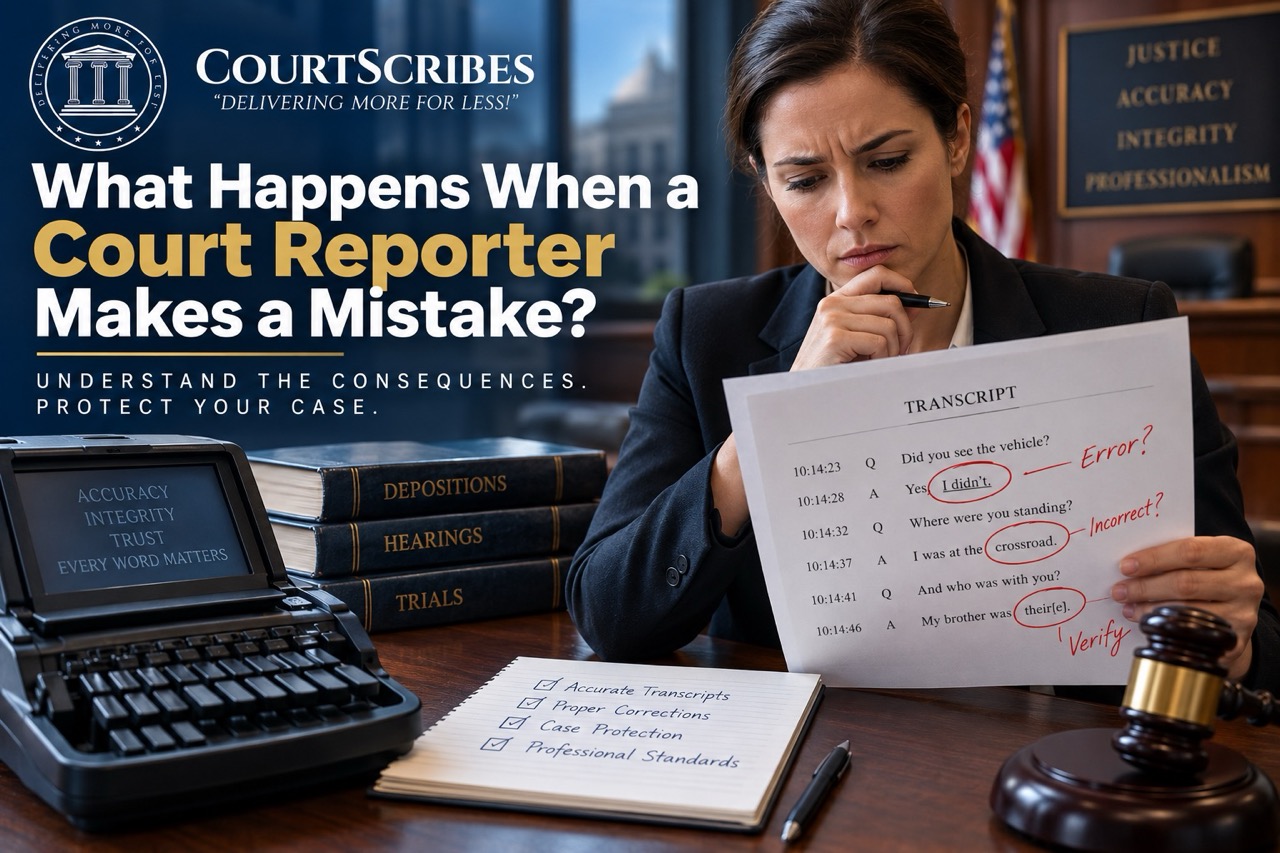
What Happens When a Court Reporter Makes a Mistake?
Court reporting errors create cascading problems affecting entire cases. A single transcript mistake can undermine months of litigation. Attorneys face serious consequences when documentation fails. Understanding error consequences helps you prevent costly mistakes. What actually happens when a court reporter makes errors? The answer involves correction procedures, judicial responses, and case impact. Professional standards exist to minimize mistakes. Even certified reporters must follow strict correction protocols. This guide explains court reporting errors and their real consequences. Learn how mistakes get corrected and prevented. Understand why professional standards matter for your cases.
Immediate Consequences: What Happens Right After Court Reporting Errors
Court reporting errors affect cases immediately upon discovery. Understanding these consequences reveals why transcript accuracy matters. Errors create urgent situations requiring rapid response. Case progression stops when court reporting errors emerge. Attorneys cannot proceed confidently with flawed documentation. Strategic decisions depend on accurate testimony records. Errors force attorneys to halt case advancement. Opposing counsel exploits court reporting errors aggressively. Weak documentation creates opportunities for dismissal motions. Admissibility challenges threaten entire transcript reliability. Errors weaken your case position immediately. Courts scrutinize transcripts when errors appear. Judicial confidence in documentation deteriorates. Judges question reporter credibility throughout proceedings. Errors damage professional reputation across courtrooms. Clients become concerned about case progression. Expensive errors waste client resources. Trust diminishes when mistakes occur. Errors threaten attorney-client relationships fundamentally.
The Correction Procedure: How Court Reporting Errors Get Fixed
Federal Rules of Civil Procedure govern transcript corrections specifically. Understanding these procedures prevents procedural violations. Proper correction requires following established protocols. Rule 30(e) establishes witness correction procedures for depositions. Witnesses receive deposition transcripts for review. Depositions typically last thirty days for review periods. Witnesses request specific corrections in writing. Reporters document changes officially on correction pages. The correction page appears after original transcript content. Changes get listed showing original and corrected text. Official documentation prevents later disputes about alterations. Proper procedure protects transcript integrity. Formal certification follows corrections completion. Reporters verify all corrections appear on correction pages. Official certification occurs after corrections finalize. Courts accept corrected transcripts when procedures follow proper rules.
Procedurally Improper Corrections
Unauthorized transcript alterations create serious legal problems. Courts reject improperly corrected documents. Understanding proper procedures prevents rejection. Post-certification changes violate evidence rules. Alterations after reporter signature face judicial scrutiny. Courts view unauthorized changes with suspicion. Improper corrections trigger transcript rejection. Substantive meaning changes face strict judicial review. Corrections fixing grammar differ from meaning changes. Courts distinguish between formatting and substantive alterations. Unauthorized meaning changes get rejected automatically. Notation failures create admissibility problems. Changes not properly documented create confusion. Courts require clear identification of all corrections. Undocumented changes suggest transcript tampering.
Long-Term Consequences: Court Reporting Errors Impact Across Cases
Court reporting errors affect litigation well beyond initial discovery. Understanding lasting consequences reveals serious risks. Errors can undermine entire case strategies. Appeal failures result from incomplete trial records. Appellate courts cannot review cases without complete transcripts. Missing portions due to reporting errors prevent appeals. Record gaps eliminate winning appeal arguments. Settlement value decreases when testimony appears unreliable. Weak documentation reduces case settlement leverage. Opposing counsel refuses reasonable settlement offers. Errors weaken negotiating positions significantly. Trial credibility suffers when court reporting errors emerge. Juries question documentation reliability. Judges scrutinize testimony from flawed transcripts. Errors damage courtroom presentation impact.
How Courts Handle Transcript Errors: Judicial Response
Judges respond to court reporting errors with varying severity. Understanding judicial reactions reveals consequences. Proper response requires acknowledging errors promptly. Minor formatting errors receive minimal judicial attention. Courts overlook trivial formatting mistakes. Punctuation errors rarely trigger serious consequences. Judges distinguish between substance and appearance problems. Speaker identification errors trigger immediate judicial concern. Courts prioritize accurate speaker attribution. Misidentified testimony creates credibility questions. Judges enforce strict speaker identification standards. Substantive testimony errors face severe judicial penalties. Meaning changes constitute serious violations. Courts may reject entire transcripts for substantive errors. Reporters face potential sanctions for serious mistakes.
When Judges Order Transcript Amendments
Judges occasionally order official transcript corrections. Understanding these situations prevents procedural violations. Judicial involvement increases correction formality. Clear error documentation triggers judicial amendments. Judges acknowledge obvious mistakes in decisions. Formal court orders direct correction procedures. Official amendments appear in court records.
Conflicting testimony versions require judicial resolution. Judges decide proper wording for disputed statements. Official orders establish binding transcript versions. Judicial intervention prevents continuing disputes. Appeal-level corrections address trial record deficiencies. Appellate judges may order record supplementation. Incomplete transcripts trigger supplementation orders. Appeals courts require complete official records.
Professional Standards: Preventing Court Reporting Errors
Professional standards exist to minimize reporting errors. Understanding these safeguards reveals quality assurance importance. Certified reporters maintain rigorous standards. Continuing education requirements maintain reporter competence. State boards mandate ongoing training hours. Specialized terminology courses improve accuracy. Professional development prevents errors.
Quality control procedures catch errors before certification. Real-time transcription enables immediate correction. Audio comparison during review catches mistakes. Multiple verification stages reduce errors. Equipment maintenance prevents technical failures causing errors. Backup systems prevent data loss. Professional grade equipment ensures recording quality. Technological reliability prevents documentation failure.
When Court Reporting Errors Trigger Professional Sanctions
Serious or repeated court reporting errors invite professional consequences. Understanding sanctions reveals accountability importance. Professional licenses protect against incompetent reporters. Complaint filing procedures begin with attorney notification. State bar associations investigate error complaints. Formal investigations trigger formal responses. Reporters have opportunity for defense.
License suspension results from serious misconduct. Repeated errors lead to suspension. Public censure accompanies gross negligence. Professional consequences create accountability. Malpractice liability emerges from serious errors. Reporters carry professional liability insurance. Coverage includes errors and omissions. Insurance protects against financial consequences.
How Court Reporting Errors Affect Different Stakeholders
Court reporting errors impact attorneys, clients, courts, and reporters. Understanding stakeholder consequences reveals error severity. Each party faces specific impacts. Attorneys face malpractice liability for inadequate documentation. Clients suffer case delays and settlement reductions. Courts experience docket congestion from error corrections. Reporters face professional discipline and reputation damage.
Impact on Attorneys and Litigation Strategy
Attorneys suffer serious consequences from reporter errors. Understanding attorney impact reveals stakes. Proper reporter selection prevents attorney problems. Case preparation suffers when transcripts prove unreliable. Attorneys cannot trust flawed documentation. Strategic decisions rest on accurate records. Errors force strategy reconsideration.
Malpractice exposure increases when attorney’s reporter makes errors. Clients may pursue malpractice claims. Insurance claims trigger premium increases. Professional liability follows inadequate reporter selection.
Impact on Clients and Case Outcomes
Clients bear financial burden of reporting errors. Understanding client impact reveals cost. Errors waste client resources. Settlement leverage decreases with weak documentation. Clients receive lower settlements due to errors. Damaged cases cost clients substantially. Errors result in financial losses. Case delays frustrate clients seeking resolution. Timeline extensions increase litigation costs. Clients become discouraged by slow progress. Errors extend case duration unnecessarily.
Preventing Court Reporting Errors: Smart Reporter Selection
Choosing qualified reporters prevents most errors. Understanding prevention strategies protects cases. Professional selection ensures reliable documentation. Verify reporter credentials before engagement. Licensed reporters maintain professional standards. Certified professionals carry liability insurance. Credential verification prevents incompetent reporter selection. Ask about quality control procedures. Professional reporters maintain multiple verification stages. Error rates should be minimal. Quality assurance practices reduce errors. Review past client references. Satisfied clients testify to reliability. Good references indicate error-free performance. Reference checks reveal reporter capability.
Frequently Asked Questions
- Can I force a reporter to fix court reporting errors? Yes, Rule 30(e) allows witness-requested corrections. Formal procedures govern correction processes. Reporters must document corrections officially. Proper procedures ensure valid corrections.
- What if the court reporter refuses to correct obvious mistakes? File complaints with state bar associations. Courts can order corrections. Judicial intervention forces compliance. Professional pressure ensures cooperation.
- Will court reporting errors cost me my case? Depends on error severity and timing. Minor errors rarely affect outcomes. Substantive errors threaten case success. Strategic timing matters for correction requests.
- How much do transcript corrections cost? Minor corrections cost nothing typically. Extensive re-transcription carries fees. Cost depends on correction extent. Ask reporters about correction pricing.
- Can I sue a reporter for making mistakes? Yes, malpractice claims are possible. Professional liability insurance covers claims. Proving damages proves challenging legally. Serious errors justify legal action.
Protect Your Cases Through Professional Standards
Court reporting errors threaten case outcomes directly. Professional standards minimize mistakes. Quality assurance prevents most problems. CourtScribes maintains rigorous error prevention standards. Our certified reporters prevent mistakes through quality control. Professional documentation protects your cases completely. Choose professional court reporting for reliable documentation.
📞 Toll-Free: 833-SCRIBES
📧 scheduling@courtscribes.com
📧 billing@courtscribes.com