
What Is Realtime Court Reporting and Why It Matters in Modern Legal Proceedings
In today’s fast-paced legal environment, access to accurate information at the right moment can make a significant difference. Legal professionals often need immediate access to testimony, statements, and arguments while proceedings are still underway. This is where realtime court reporting becomes invaluable.
Realtime court reporting provides live transcription of spoken words during legal proceedings such as hearings, depositions, trials, arbitrations, and mediations. Instead of waiting hours or days for a completed transcript, attorneys, judges, and legal teams can read the spoken record instantly on a screen. This technology-driven service improves communication, enhances decision-making, and ensures that no critical detail is missed during complex legal proceedings.
What Is Realtime Court Reporting?
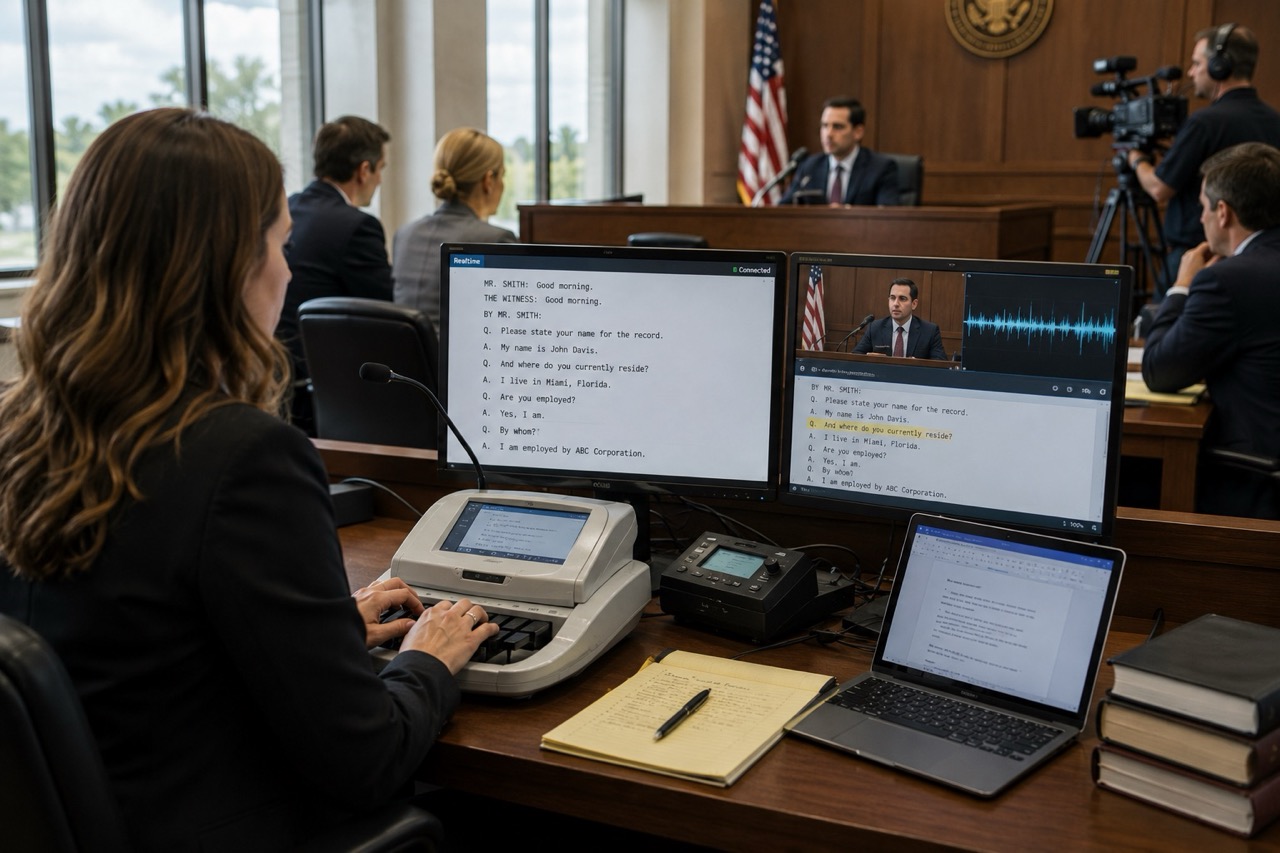
Realtime court reporting is a specialized service in which a certified court reporter transcribes spoken words into text instantly as participants speak. Using stenographic equipment and advanced transcription software, the reporter converts speech into readable text in real time.
The transcript is streamed live to connected devices such as laptops, tablets, or monitors. This allows legal teams to follow every statement as it happens. Unlike traditional transcription, where the final transcript is delivered after proceedings end, realtime reporting gives immediate access to the official record. This instant visibility can be especially useful during lengthy or high-stakes legal matters.
How Realtime Court Reporting Works
Realtime court reporting combines the expertise of highly trained court reporters with advanced transcription technology to produce accurate live transcripts during legal proceedings. This process ensures that every spoken word is captured, translated, and delivered instantly to authorized participants. From the moment someone speaks until the final transcript is certified, multiple stages work together to maintain both speed and accuracy.
1. Speech Capture by a Court Reporter
The process begins with a professional court reporter who is specially trained to capture speech at extremely high speeds and with exceptional precision. During hearings, depositions, trials, arbitrations, or mediations, the reporter listens closely to every spoken word, including witness testimony, attorney arguments, judicial comments, and objections.
Instead of using a standard keyboard, court reporters work with a specialized machine called a stenotype machine. This device allows them to press multiple keys simultaneously to record phonetic sounds, syllables, and words in shorthand form. Because of this system, experienced reporters can transcribe speech at speeds exceeding 200 words per minute while maintaining remarkable accuracy.
The reporter must also identify speakers, note interruptions, mark nonverbal actions when relevant, and handle situations involving rapid exchanges or overlapping speech. Human expertise is essential here, as legal proceedings often involve complex terminology, technical jargon, and nuanced communication that automated systems may struggle to interpret correctly.
2. Translation Through Specialized Software
Once the reporter enters shorthand strokes into the stenotype machine, specialized realtime transcription software immediately begins translating those strokes into readable English text. This software relies on extensive dictionaries, customized legal terminology databases, and translation algorithms designed specifically for court reporting. Many reporters personalize their dictionaries to include frequently used legal phrases, case-specific terminology, names of participants, and industry-specific vocabulary.
As the proceeding continues, the software converts shorthand input into text within seconds. This rapid translation enables a nearly seamless flow from spoken language to written transcript.
Advanced software also helps minimize errors by recognizing patterns, correcting predefined entries, and improving translation efficiency over time. However, software alone is not enough. The accuracy of realtime reporting still depends heavily on the skill, preparation, and expertise of the court reporter operating the system.
3. Live Transcript Delivery
After translation, the text is delivered instantly to connected devices such as laptops, tablets, monitors, or secure cloud-based platforms. This allows attorneys, judges, paralegals, and support staff to read the transcript as the proceeding unfolds.
Live transcript access provides a major strategic advantage. Legal teams can monitor testimony in real time, highlight critical statements, annotate key moments, and flag inconsistencies without waiting for the proceeding to end. For example, if a witness makes a statement that contradicts earlier testimony, attorneys can immediately reference the transcript and adjust their questioning strategy. Judges may also use realtime transcripts to review specific testimony before making procedural decisions.
In remote or hybrid proceedings, live transcript delivery becomes even more valuable. Team members participating from different locations can follow the exact conversation simultaneously, improving coordination and communication across the legal team.
4. Transcript Review and Finalization
Although realtime transcripts are highly accurate, the process does not end when the proceeding concludes. After the session, the court reporter carefully reviews the transcript to ensure it meets professional and legal accuracy standards.
This review stage involves correcting translation issues, verifying speaker identification, resolving unclear portions, checking punctuation, and confirming legal terminology. The reporter may also cross-reference notes or audio recordings when necessary to eliminate ambiguity. Once editing is complete, the transcript is finalized and prepared as a certified legal record. This final version becomes an official document that may be used for case preparation, appeals, evidence review, legal analysis, or future proceedings.
The review and certification process ensures that legal professionals receive not only immediate access to spoken information but also a polished and reliable final transcript suitable for formal legal use.
Overall, realtime court reporting delivers the best of both worlds: instant visibility during proceedings and dependable final documentation afterward. By combining human expertise with specialized technology, it provides legal teams with a powerful tool for improving efficiency, accuracy, and decision-making.
Benefits of Realtime Court Reporting
Realtime court reporting offers several major advantages over traditional transcription methods, making it an increasingly valuable service in modern legal proceedings. By providing instant access to spoken testimony and discussions, it enhances efficiency, strengthens legal strategy, and improves communication among all participants. Whether used in depositions, hearings, trials, arbitration, or mediation, realtime reporting helps legal professionals work with greater confidence and precision.
Instant Access to Testimony
One of the most significant benefits of realtime court reporting is immediate access to spoken statements as they occur. In traditional transcription, legal teams often need to wait hours or even days before receiving the official transcript. During that waiting period, important details may be forgotten or misremembered.
With realtime reporting, attorneys and legal professionals can read testimony live on their screens. This eliminates the need to rely solely on handwritten notes or memory. Every statement, answer, objection, and argument becomes instantly accessible.
This immediate visibility is especially valuable when a witness provides critical testimony or reveals unexpected information. Legal teams can quickly revisit exact wording and use that information to shape their next steps during the proceeding itself.
Better Note-Taking and Organization
Legal proceedings often generate a large amount of information within a short time. Keeping accurate notes while simultaneously listening, analyzing, and preparing responses can be challenging for attorneys. Realtime transcripts greatly improve note-taking by allowing legal professionals to annotate the live transcript directly. Attorneys can highlight key testimony, mark important sections, flag inconsistencies, and add case-related notes in real time.
This level of organization helps legal teams manage information more efficiently. Instead of scrambling to write every detail manually, they can focus on analysis and strategy while using the transcript as a reliable reference. Better organization also improves case preparation after the proceeding, making it easier to review testimony, build arguments, and prepare for future legal actions.
Faster Strategic Decisions
Legal proceedings can change rapidly. A witness may contradict earlier testimony, opposing counsel may introduce unexpected arguments, or new evidence may shift the direction of questioning. In such moments, quick and informed decisions are essential. Realtime court reporting gives attorneys immediate access to exact spoken language, allowing them to respond with greater precision. Instead of asking for repeated statements or depending on memory, they can verify wording instantly.
This speed supports stronger strategic decision-making. Lawyers can adjust questioning, challenge inconsistencies, raise objections, or modify legal arguments based on accurate real-time information. In high-stakes cases, the ability to react quickly can significantly influence outcomes.
Improved Team Collaboration
Large legal cases often involve multiple professionals working together, including lead attorneys, co-counsel, paralegals, legal assistants, and subject-matter experts. Effective collaboration among these team members is critical. Realtime court reporting enables multiple authorized participants to access the transcript simultaneously. This shared access allows team members to monitor proceedings together and communicate more effectively.
For example, while one attorney leads questioning, another team member can review live testimony, identify inconsistencies, and suggest follow-up questions. Paralegals can organize supporting documents while comparing them against current statements. This collaborative workflow becomes even more valuable in remote or hybrid legal environments, where team members may be participating from different locations. Live transcript access ensures everyone remains informed and aligned.
Reduced Risk of Missing Important Details
Court hearings, depositions, and arbitration sessions often involve long hours of testimony, legal arguments, and detailed discussions. Even experienced legal professionals can miss critical details due to fatigue, distractions, or the speed of conversation. Realtime reporting significantly reduces this risk by creating a continuous live record of everything said during the proceeding.
If a witness uses important wording, makes a subtle admission, or introduces contradictory information, the transcript preserves that exact statement instantly. Legal teams can review and verify details before those moments are lost. This reduces misunderstandings and minimizes the chances of overlooking testimony that could affect case strategy, negotiations, or final decisions.
Greater Accuracy and Reliability
Another major benefit of realtime court reporting is improved accuracy in legal documentation. Legal matters often depend on exact wording, and even minor errors can create confusion or impact case outcomes. Because realtime reporting is performed by trained court reporters using specialized equipment and software, the resulting transcripts maintain a high level of precision.
The combination of human expertise and advanced technology ensures that complex legal terminology, speaker identification, and procedural details are captured accurately. This reliability gives attorneys greater confidence in the records they use for analysis, appeals, and case preparation.
Increased Efficiency and Productivity
Realtime court reporting also improves overall workflow efficiency. Legal teams spend less time reconstructing testimony from memory or waiting for transcripts to arrive after proceedings. Instant access to information streamlines communication, reduces delays, and helps professionals work more productively during and after legal sessions.
By minimizing manual note-taking and speeding up information retrieval, realtime reporting allows attorneys to devote more attention to advocacy, negotiation, and strategic planning. Overall, realtime court reporting offers substantial advantages for modern legal practice. From instant access to testimony and better collaboration to faster decision-making and improved accuracy, it provides a powerful solution for legal teams seeking efficiency and precision in every proceeding.
Where Realtime Court Reporting Is Used
Realtime court reporting is widely used across a variety of legal and dispute-resolution settings where accurate, immediate documentation is essential. In environments where decisions often depend on precise wording and timely responses, live transcription provides a major advantage. By delivering spoken content instantly, realtime reporting helps legal professionals maintain clarity, improve communication, and respond effectively during proceedings.
Court Hearings
Court hearings often involve fast-moving legal discussions, procedural arguments, witness testimony, and judicial rulings. In these settings, even small details can influence important decisions.
Realtime court reporting allows judges and attorneys to follow the official record as events unfold. Instead of relying solely on notes or memory, they can reference exact statements immediately. This is especially useful when reviewing objections, clarifying testimony, or verifying the wording of legal arguments.
For judges, live transcripts can support more informed rulings by allowing quick review of statements made earlier in the hearing. For attorneys, they provide an immediate resource for building stronger arguments and identifying inconsistencies in testimony.
Depositions
Depositions are one of the most common settings for realtime court reporting. During depositions, attorneys question witnesses under oath, often gathering critical evidence that may shape the direction of a case. Because witness statements can contain subtle details, contradictions, or key admissions, instant access to testimony is extremely valuable. Realtime transcripts allow attorneys to monitor responses closely and adjust their questioning strategy as needed.
If a witness changes a previous statement or provides inconsistent answers, attorneys can quickly reference earlier testimony and address the discrepancy on the spot. This strengthens examination and improves the quality of information collected during questioning. Realtime reporting also helps legal teams organize deposition records more efficiently for later case preparation.
Trials
Trials are often complex, high-pressure proceedings involving multiple witnesses, legal arguments, exhibits, and judicial instructions. Information moves quickly, and attorneys must remain highly responsive. Realtime transcripts provide trial teams with immediate access to every spoken word in the courtroom. This allows attorneys to review testimony, monitor witness statements, and respond strategically without delay.
For example, if a witness introduces unexpected testimony or contradicts prior statements, attorneys can instantly review the transcript and prepare an effective response. This capability supports cross-examination, objection handling, and evidence presentation. In lengthy trials, realtime reporting also reduces the cognitive burden on legal teams by ensuring that no important detail is lost during fast-paced proceedings.
Arbitration
Arbitration is a widely used form of alternative dispute resolution where disputes are resolved outside traditional courtrooms. Although arbitration is often less formal than litigation, accurate documentation remains essential.
Realtime court reporting provides arbitrators, attorneys, and involved parties with a precise record of all statements, arguments, and rulings during arbitration sessions.
Because arbitration outcomes may affect financial, contractual, or business matters, maintaining an accurate transcript can be crucial for future reference, compliance, or potential appeals. Live transcripts also help participants track complex discussions and ensure clarity throughout the proceeding.
For commercial disputes or multi-party arbitration cases, realtime reporting offers particularly strong value by improving transparency and reducing misunderstandings.
Mediation
Mediation focuses on negotiation and conflict resolution, often with the goal of reaching mutually acceptable agreements outside of court. While mediation is generally collaborative, discussions can still involve complex terms, sensitive negotiations, and detailed proposals. Realtime transcripts help participants track offers, statements, commitments, and negotiation progress as discussions unfold. This can reduce confusion and improve communication between parties.
Mediators may also benefit from live documentation when clarifying prior statements or summarizing areas of agreement and disagreement. Having an accurate record helps ensure that important commitments are clearly understood by all parties. In complex business, employment, or contractual disputes, realtime reporting can help preserve clarity throughout the mediation process. Overall, any legal proceeding where speed, precision, and reliable documentation matter can benefit significantly from realtime court reporting.
Why Accuracy Matters in Legal Proceedings
Accuracy is one of the most critical elements in any legal proceeding. In law, outcomes often depend not only on what was said but also on exactly how it was said. A single misheard phrase, omitted word, or incorrect interpretation can influence legal strategy, negotiations, rulings, or final judgments.
Legal professionals routinely rely on transcripts to analyze testimony, prepare arguments, challenge inconsistencies, and support appeals. If the record contains inaccuracies, those errors can create confusion and weaken decision-making.
The Importance of Precise Language
Legal communication often involves highly specific terminology, carefully structured arguments, and precise wording. Small language differences can carry major legal implications.
For example, a slight change in wording may alter the meaning of a witness statement or affect how evidence is interpreted. Attorneys frequently examine exact phrasing during cross-examination, settlement discussions, and appeals. This makes precise transcription essential. Reliable transcripts ensure that every statement is preserved exactly as spoken.
Challenges for Automated Speech Recognition
Although AI-powered speech recognition technology has improved significantly in recent years, fully automated systems still face major challenges in legal environments.
Legal proceedings frequently include:
- Complex legal terminology
- Multiple speakers talking rapidly
- Overlapping conversations
- Strong regional or international accents
- Background noise or courtroom interruptions
- Technical industry-specific vocabulary
Automated systems often struggle in these situations. They may misidentify speakers, misunderstand specialized terms, or fail to accurately capture overlapping dialogue. Even minor transcription errors can create costly misunderstandings in legal contexts.
Why Human Court Reporters Remain Essential
This is why skilled human court reporters continue to play an essential role in modern legal proceedings. Professional court reporters bring judgment, contextual understanding, and specialized training that automated tools cannot fully replicate. They can recognize speaker changes, interpret unclear speech, identify legal terminology, and maintain accuracy even under challenging conditions. Their expertise ensures that transcripts remain dependable and legally reliable.
The Best Approach: Technology Plus Human Expertise
The most effective realtime reporting services combine advanced transcription technology with professional human oversight. Technology provides speed, live delivery, and workflow efficiency, while human reporters ensure accuracy, context, and quality control. This combination creates a powerful solution for legal teams that need both immediate access and trustworthy documentation.
In legal proceedings, accuracy is not just beneficial, it is essential. Reliable realtime court reporting helps protect the integrity of the legal record and supports better decision-making at every stage of a case.
Choosing the Right Realtime Court Reporting Service
Not all court reporting providers offer the same level of expertise, reliability, or technological capability. Choosing the right realtime court reporting service is critical for maintaining accurate legal records and ensuring smooth proceedings. Since legal decisions often depend on precise documentation, selecting a trustworthy reporting partner can directly affect workflow efficiency, case preparation, and overall legal strategy.
When evaluating a realtime court reporting service, several important factors should be considered.
Experience in Legal Proceedings
One of the first factors to examine is the provider’s experience within legal environments. Court reporting requires more than fast typing or transcription software. It demands a deep understanding of legal procedures, terminology, courtroom etiquette, and the dynamics of formal proceedings.
A reliable provider should have proven experience handling a wide range of legal settings, including hearings, depositions, trials, arbitration sessions, and mediations. Experienced reporters are better prepared to manage fast-paced questioning, complex legal arguments, multiple speakers, and technical terminology. Providers with strong legal expertise are more likely to deliver transcripts that accurately capture both the content and context of proceedings.
Accuracy Standards
Accuracy remains the most important factor in court reporting. Even small transcription errors can create confusion, weaken legal arguments, or affect case outcomes. High-quality reporting services maintain strict quality-control procedures to ensure transcript reliability. These procedures may include dictionary customization, transcript review, proofreading, and post-session verification.
When choosing a provider, legal teams should evaluate their reputation for precision and consistency. Certifications, professional credentials, and industry experience can also indicate strong quality standards. The best providers prioritize accuracy at every stage, from live transcription to final transcript delivery.
Technology and Compatibility
Modern realtime court reporting depends heavily on reliable technology. Advanced reporting software, stable streaming systems, and device compatibility all play essential roles in delivering a smooth live transcription experience.
A quality provider should offer dependable realtime viewing solutions that function across multiple devices, including laptops, tablets, and secure remote-access platforms. This flexibility allows attorneys, judges, and legal staff to access live transcripts wherever they are.
Technology failures during critical proceedings can cause delays and communication issues. For this reason, providers should also have backup systems and technical support available to minimize disruption. Strong technology infrastructure ensures that live transcripts remain accessible, responsive, and easy to use.
Confidentiality and Security
Legal proceedings often involve highly sensitive and confidential information, including personal records, financial data, corporate disputes, and privileged communications. Protecting this information is essential. A trustworthy court reporting provider should follow strict data security protocols to safeguard transcripts and client information. This may include secure file storage, encrypted data transmission, password-protected access, and confidentiality agreements.
Before selecting a provider, legal teams should assess how the company handles data privacy and security compliance. Strong security practices help prevent unauthorized access and maintain client trust. In legal work, confidentiality is not optional. It is a fundamental requirement.
Turnaround Support
Realtime access is valuable during proceedings, but legal professionals also need professionally finalized transcripts after the session ends. Reliable providers offer both live reporting and efficient post-proceeding transcript delivery.
Turnaround time can be especially important in urgent cases involving appeals, deadlines, or fast-moving litigation. Delayed transcript delivery may slow case preparation and reduce efficiency.
The best reporting providers offer flexible delivery options, responsive support, and clear communication regarding transcript availability. Fast and dependable turnaround ensures legal teams can continue working without unnecessary delays.
Ultimately, a trusted reporting partner does more than provide transcripts. They help legal teams stay organized, informed, and fully prepared throughout every stage of a case.
The Future of Realtime Court Reporting
As legal technology continues to evolve, realtime court reporting services are becoming increasingly sophisticated and accessible. Advances in software, connectivity, and digital collaboration are reshaping how legal professionals access and use live transcripts.
Remote proceedings have accelerated demand for flexible reporting solutions. Cloud-based transcript sharing now allows attorneys, judges, and support teams to access live records from virtually any location. This has made realtime reporting especially valuable in hybrid and remote legal environments.
Improved collaborative tools are also enhancing the user experience. Features such as live annotations, searchable transcripts, instant keyword lookup, and synchronized team access help legal professionals work more efficiently than ever before.
Artificial intelligence is expected to continue influencing the field by improving workflow automation and software assistance. However, despite these technological advancements, the core value of realtime reporting remains unchanged. Legal proceedings require more than speed. They require precision, contextual understanding, and dependable human oversight.
This is why professional court reporters will continue to play a central role in the future of legal transcription. Technology may enhance efficiency, but human expertise remains essential for ensuring accuracy and reliability. In a profession where every word matters, realtime court reporting will continue to be one of the most valuable tools available to legal professionals.
Frequently Asked Questions About Realtime Court Reporting
1. What is realtime court reporting?
Realtime court reporting is the live transcription of legal proceedings as they happen, allowing participants to read spoken words instantly.
2. How is realtime reporting different from standard transcription?
Standard transcription is delivered after proceedings end, while realtime reporting provides immediate live access to the transcript.
3. Who uses realtime court reporting?
Attorneys, judges, paralegals, arbitrators, mediators, and legal support teams commonly use realtime reporting.
4. Is realtime court reporting accurate?
Yes. Professional court reporters combined with specialized software deliver highly accurate transcripts.
5. Can legal teams access transcripts remotely?
Many modern providers offer remote transcript access through secure cloud-based platforms.
6. Is realtime reporting useful during depositions?
Yes. It allows attorneys to review testimony instantly and respond strategically.
7. What equipment is needed for realtime reporting?
Court reporters typically use stenotype machines, transcription software, and connected viewing devices.
8. Is a final transcript provided afterward?
Yes. Most services provide a reviewed and certified final transcript after the proceeding.
9. Is realtime court reporting secure?
Reputable providers use secure systems to protect confidential legal information.
10. How much does realtime court reporting cost?
Costs vary depending on proceeding length, complexity, location, and service provider.
Finally
Realtime court reporting has transformed the way legal professionals manage and analyze information during proceedings. By delivering instant access to spoken testimony, legal arguments, and critical discussions, it creates a faster and more informed decision-making environment.
This technology improves workflow efficiency, strengthens case strategy, and enhances communication among attorneys, judges, and legal support teams. Instead of relying solely on memory or handwritten notes, legal professionals can work with immediate access to an accurate record.
Whether used in depositions, court hearings, arbitration, mediation, or trials, realtime reporting ensures that important details are captured the moment they are spoken.
As legal proceedings become more complex and technology-driven, the demand for reliable live transcription will continue to grow. For legal teams seeking greater speed, stronger accuracy, and improved collaboration, realtime court reporting remains an essential modern solution.
Call Us
Toll Free 833-SCRIBES
Email Us
Scheduling: scheduling@courtscribes.com
Billing: billing@courtscribes.com