
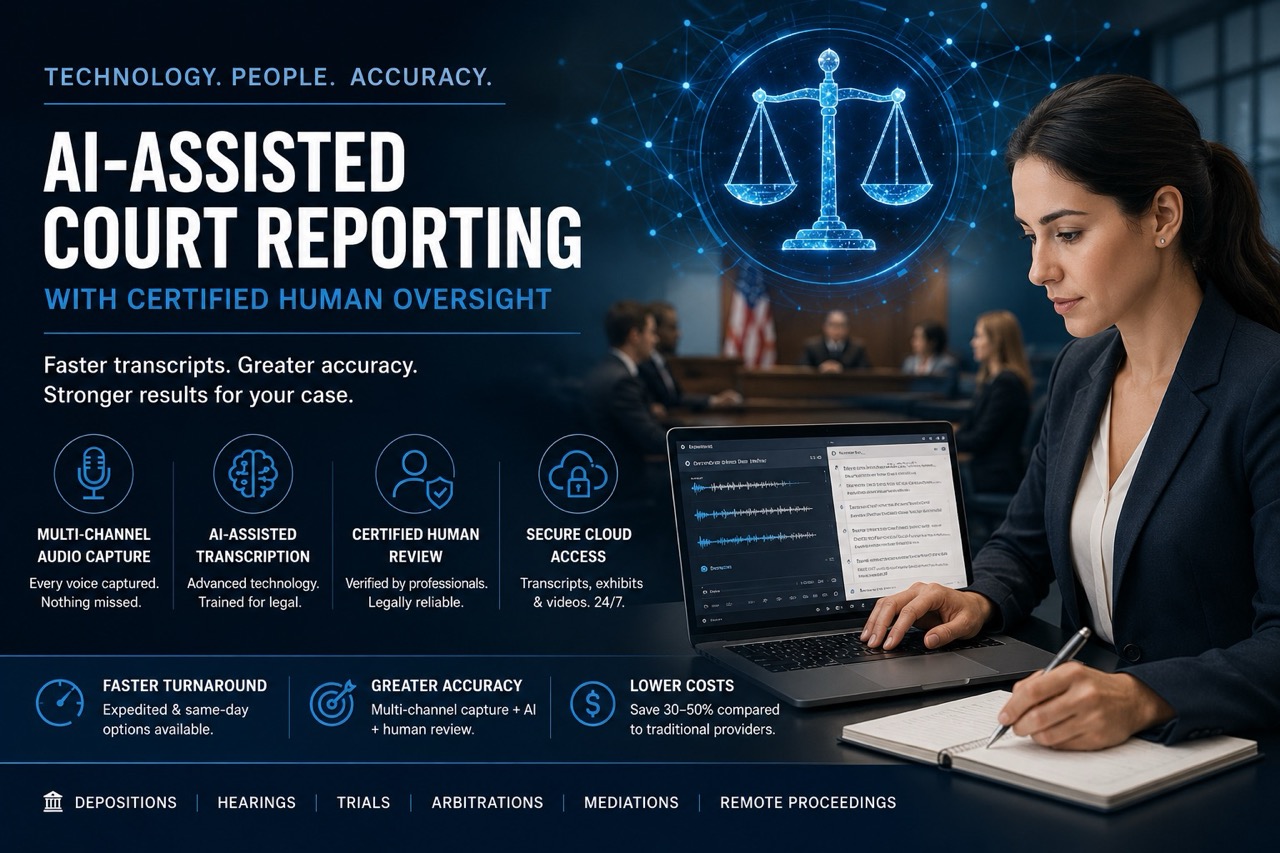
Technology-Driven Court Reporting With Certified Human Oversight
Court reporting technology has changed dramatically over the last decade. Legal proceedings no longer depend entirely on isolated transcription workflows or delayed transcript delivery systems that struggle to keep up with modern litigation demands. Attorneys now need faster access to testimony, more organized litigation records, reliable remote participation tools, and transcript systems that maintain accuracy even during high-volume proceedings. That shift has led to the rapid growth of AI-assisted court reporting services supported by certified human review.
At CourtScribes, Modern law firms, insurance defense teams, corporate legal departments, plaintiff firms, and government agencies increasingly rely on AI-assisted court reporting services. These systems combine advanced technology with professional oversight. Artificial intelligence helps accelerate transcript processing, organize audio data, improve search functionality, and streamline legal workflows. Certified reporting professionals then review, verify, and finalize the transcript to maintain legal reliability and procedural consistency.
Why the Legal Industry Is Moving Toward AI-Assisted Court Reporting Services
The legal industry is moving toward AI-assisted court reporting services because modern litigation demands cleaner capture, faster processing, and stronger verification than traditional single-listener workflows can always provide. Traditional stenography depends on one skilled professional hearing and recording testimony in real time from one position in the room.
That method reflects real expertise, but overlapping speakers, quiet witnesses, unfamiliar terminology, and tense deposition environments can create judgment calls that never appear in the final transcript. At CourtScribes, we address this structural problem with dedicated high-definition microphones placed in front of each participant, creating separate audio channels throughout the proceeding. When speakers overlap or a voice drops, the recording preserves each channel for review.
AI-assisted transcription then processes every channel efficiently, and a certified human reviewer checks the transcript against the original audio before delivery. This workflow supports stronger accuracy, clearer verification, faster turnaround, and a more dependable record for attorneys managing complex depositions, hearings, trials, and remote legal proceedings.
The Three-Stage Process Behind Every CourtScribes Transcript
Every CourtScribes transcript follows a structured three-stage process designed to protect accuracy, speed, and legal reliability. Our workflow combines multi-channel audio capture, AI-assisted transcription, and certified human review so attorneys receive a professional record that reflects the proceeding clearly, supports verification, and meets legal documentation expectations.
Stage One: Multi-Channel Audio Capture
Before a proceeding begins, CourtScribes sets up dedicated high-definition microphones in front of every participant in the room. A deposition with four parties gets four independent audio channels. A hearing with a judge, two counsel, and a witness gets four separate capture streams running from the moment the session begins. This configuration applies whether the proceeding is fully in-person, hybrid with some participants remote, or entirely remote through a CourtScribes-managed video session. No speaker is dependent on proximity to a shared microphone, and no overlap between speakers results in lost audio on any channel.
The multi-channel configuration is the foundational advantage of AI-assisted court reporting services over traditional single-point transcription. It removes the structural constraint that forces a stenographer to choose between overlapping speakers, because the capture system never has to choose. Every channel is running independently, and all of them feed into the transcription stage.
Stage Two: AI-Assisted Transcription
Once the session concludes, the multi-channel audio goes through AI-assisted transcription. The system is trained on legal language, which means it handles domain-specific vocabulary, citation formats, and procedural terminology more accurately than general-purpose speech recognition. Legal terms that phonetically resemble common words, proper nouns that appear without context, and specialized technical language from medicine, engineering, or finance are all processed against a legal-domain knowledge base rather than a general language model.
The output at this stage is a high-accuracy draft reflecting every audio channel from the full session. The speed and consistency of AI processing is one of the defining advantages of AI-assisted court reporting services over the traditional model: it is what allows CourtScribes to offer expedited and same-day rough draft delivery as standard service options rather than premium add-ons. The computational work that would take a human reporter many hours to complete is done in a fraction of that time.
Stage Three: Certified Human Review
This is the stage that makes the transcript legally defensible. A certified human reporter reviews the AI output line by line against the original multi-channel audio recording. They correct errors the algorithm produced, verify that proper nouns, names, and specialized terminology are rendered correctly, and ensure the final transcript accurately reflects what every participant said from start to finish. The reporter applies the professional judgment and legal domain expertise that certification requires and that machine learning cannot replicate reliably in every context.
The certified transcript that emerges from this review is what AI-assisted court reporting services are designed to produce: not an AI document with human sign-off, but a professionally certified legal record that went through computational processing for greater accuracy, then through professional certification to meet every legal and admissibility standard the jurisdiction requires. The methodology and comparative accuracy results are examined in detail in the White Paper which includes the direct error-rate comparison between this process and a competing stenographer-produced transcript of the same proceeding.
Accuracy, Cost, and What Attorneys Actually Gain
The accuracy advantage of AI-assisted court reporting services is not a claim that exists only in marketing materials. It is documented in a direct comparison of transcripts produced by both methods from the same proceedings. The CourtScribes version had significantly fewer errors per page. For attorneys whose cases turn on the precise wording of testimony, whether a witness said “I was aware” or “I became aware,” whether a timeline was described as “approximately” or “exactly,” that accuracy gap has direct consequences for discovery, for motion practice, and sometimes for trial outcome.
The cost picture is equally concrete. CourtScribes delivers consistent savings of 30 to 50 percent compared to traditional agencies for equivalent services. The savings come from a cloud-based operational model with remote transcriptionists and integrated technology rather than the physical infrastructure and overhead that traditional agencies carry.
The current benchmarks for speech-to-text accuracy in legal transcription show that AI-assisted systems trained on legal language now outperform unassisted stenography in multi-speaker, high-pressure environments. The legal industry is catching up to what the data has been showing for several years. Attorneys who have made the transition consistently describe the experience as the same upgrade attorneys have always described when moving from an inferior tool to a better one: they wonder why they waited.
Repository Access and Post-Proceeding Record Management
Every CourtScribes client receives free, secure, permanent 24/7 access to transcripts, exhibits, and video recordings through our private repository. Once a record is certified and posted, legal teams can access it immediately from any device without calling the agency, waiting for file delivery, or tracking down missing exhibits from past proceedings.
This matters especially in complex litigation, where attorneys may rely on AI-assisted court reporting services across multiple depositions, hearings, and trial preparation sessions. A centralized record platform keeps every certified transcript, marked exhibit, and video recording organized by case and searchable from the moment it becomes available.
Instead of losing time inside disconnected folders, email chains, or outside drives, legal teams can work from one dependable source of truth. CourtScribes designed this repository to support faster review, smoother collaboration, and stronger preparation throughout the life of a matter, helping firms manage post-proceeding records with greater control and efficiency.
The Benefits of AI-Assisted Court Reporting Services
Modern litigation environments move quickly. Attorneys often need transcript access immediately after proceedings conclude, especially during active discovery, emergency motions, trial preparation, and large-scale litigation. AI-Assisted Court Reporting Services help legal teams improve workflow efficiency by supporting:
- Faster transcript processing: AI-assisted workflows help CourtScribes process proceeding audio more efficiently, reducing delays after depositions, hearings, and trials while still keeping certified human review in place.
- Improved search functionality: Legal teams can search testimony, names, objections, and key terms faster, making transcript review more efficient during discovery, motion preparation, and trial planning.
- Better organization of testimony: CourtScribes helps organize transcripts, exhibits, and legal videos in one centralized system, giving attorneys clearer access to important testimony across active litigation matters.
- More scalable litigation support: AI-assisted systems help support high-volume cases involving multiple depositions, remote participants, large exhibit sets, and ongoing transcript needs without disrupting workflow quality.
- Cloud-based transcript access: Attorneys can securely access transcripts, exhibits, and videos from any device, allowing faster review and smoother coordination across offices, teams, and case locations.
- Faster remote collaboration: Legal teams can review shared records, monitor testimony, and coordinate strategy more efficiently when attorneys, witnesses, experts, or support staff work from different locations.
At CourtScribes, our reporting systems help legal teams access transcripts, exhibits, and legal videos from one centralized platform designed specifically for active litigation workflow management.
Remote Deposition Technology Built for Modern Litigation
Remote depositions have become a standard part of modern litigation because attorneys regularly manage proceedings involving participants located across different states, countries, and legal jurisdictions. At CourtScribes, our secure remote deposition platforms integrate directly into our AI-Assisted Court Reporting Services workflow to help legal teams maintain organized and dependable proceedings regardless of location.
These systems support secure video conferencing, real-time transcript streaming, digital exhibit presentation, remote participant coordination, cloud-based transcript access, legal videography integration, interpreter coordination, and live technical support throughout the session. Attorneys can access additional support resources through our Virtual Court Appearance solutions designed specifically for remote legal environments.
By combining AI-supported workflow systems with certified human review and structured technical coordination, CourtScribes helps attorneys conduct remote depositions with the same level of organization, transcript reliability, and procedural consistency expected during in-person proceedings. This integrated approach allows legal teams to reduce scheduling delays while maintaining efficient communication, organized exhibit handling, and dependable legal documentation throughout active litigation matters.
Integrated Legal Videography and Transcript Navigation Tools
Written transcripts remain one of the most important components of any legal proceeding, but legal videography often provides additional context that attorneys rely on during witness evaluation, trial preparation, settlement review, and impeachment strategy. At CourtScribes, we coordinate professional legal videography directly alongside our AI-Assisted Court Reporting Services so attorneys receive synchronized transcript and video records through one integrated litigation support workflow.
Our systems support video-to-text synchronization, searchable testimony review, time-stamped transcript navigation, remote video access, trial presentation support, witness behavior review, and multi-device accessibility for attorneys working across different offices or jurisdictions. Legal teams can click on any word within the transcript and immediately access the matching video segment, helping attorneys review testimony more efficiently during active litigation.
This synchronized workflow becomes especially valuable during complex depositions, expert witness proceedings, and trial preparation where attorneys need rapid access to specific testimony moments. Additional details about these capabilities are available through our Legal Video Services support resources and litigation technology solutions.
Interpreter Coordination for Multilingual Legal Proceedings
Modern litigation frequently involves multilingual testimony that requires careful coordination between interpreters, attorneys, court reporters, videographers, and technical support personnel. Depositions involving international parties, multilingual witnesses, or remote participants often become significantly more difficult without structured interpretation coordination integrated directly into the reporting workflow.
At CourtScribes, we coordinate interpreter services within our AI-Assisted Court Reporting Services infrastructure to help legal teams maintain organized communication and dependable transcript consistency throughout multilingual proceedings. Our services commonly support Spanish interpretation, Haitian Creole interpretation, Portuguese interpretation, multilingual depositions, remote interpreted proceedings, interpreter-integrated transcripts, and international witness coordination for complex litigation environments.
This integrated workflow helps attorneys reduce communication confusion while preserving more organized legal documentation throughout testimony and exhibit review. By combining AI-supported organization systems with certified human transcript review and professional interpreter coordination, CourtScribes helps legal professionals maintain a smoother litigation workflow even when proceedings involve multiple languages, international participants, or remote testimony requiring careful communication management.
Why Modern Law Firms Continue Choosing CourtScribes
Attorneys handling modern litigation need court reporting systems that remain organized, responsive, and dependable under demanding legal conditions involving remote participants, multi-party proceedings, large exhibit sets, and complex scheduling coordination. Delays, disorganized transcripts, poor communication, or unreliable technical systems can disrupt litigation workflow and create unnecessary procedural complications during active cases.
Law firms continue choosing CourtScribes because we combine certified human transcript review, AI-supported reporting systems, remote deposition technology, legal videography, transcript synchronization, secure cloud repositories, interpreter coordination, responsive scheduling, and national litigation support within one integrated reporting workflow.
Whether proceedings occur inside federal courthouses, arbitration centers, downtown law office conference suites, remote video platforms, or hybrid legal environments, CourtScribes helps legal professionals maintain organized and accurate records throughout every stage of litigation. Our service areas include Florida, Delaware, New York, New Jersey, Maine, Washington D.C., and nationwide coverage across all 50 states.
FAQs about AI-Assisted Court Reporting Services
Q1. What are AI-Assisted Court Reporting Services?
AI-Assisted Court Reporting Services combine artificial intelligence tools with certified human transcript review to support organized, accurate, and scalable legal reporting workflows.
Q2. Does AI replace certified court reporters?
No. At CourtScribes, artificial intelligence supports workflow efficiency while certified professionals still review, verify, and finalize transcripts for legal use.
Q3. Are AI-assisted transcripts legally valid?
Yes. CourtScribes transcripts receive certified human review before final delivery to help maintain procedural reliability and legal usability.
Q4. How does AI improve court reporting workflows?
AI helps organize audio data, improve search functionality, accelerate transcript processing, support speaker separation, and streamline litigation workflow management.
Q5. Can AI-Assisted Court Reporting Services support remote depositions?
Yes. CourtScribes supports secure remote depositions with transcript streaming, exhibit management, videography integration, and certified transcript delivery.
Q6. Does CourtScribes provide legal videography?
Yes. We coordinate professional legal videography with synchronized transcript review and searchable video-to-text technology.
Q7. How are transcripts stored and accessed?
CourtScribes provides secure cloud-based access to transcripts, exhibits, and legal videos through a centralized repository available 24/7.
Q8. Can multilingual proceedings be supported?
Yes. CourtScribes coordinates interpreter services for Spanish, Haitian Creole, Portuguese, and other multilingual proceedings.
Q9. What types of cases benefit most from AI-Assisted Court Reporting Services?
Complex litigation, class actions, commercial disputes, insurance defense matters, remote depositions, multi-party proceedings, and high-volume litigation all benefit from organized AI-supported workflows.
Q10. How do I schedule a proceeding with CourtScribes?
You can schedule online, call 833-SCRIBES, or email scheduling@courtscribes.com to coordinate depositions, hearings, trials, arbitrations, and remote proceedings.
Schedule AI-Assisted Court Reporting Services Today
Modern litigation requires reporting systems that combine technology, organization, scalability, and professional oversight. CourtScribes provides AI-Assisted Court Reporting Services supported by certified human review, secure cloud access, real-time reporting, legal videography, remote deposition technology, and nationwide litigation support. Contact CourtScribes today to schedule your next deposition, hearing, arbitration, mediation, trial, or remote proceeding.
Call Toll-Free: 833-SCRIBES
Scheduling: scheduling@courtscribes.com
Billing: billing@courtscribes.com