
What Tools Do Court Reporters Use?
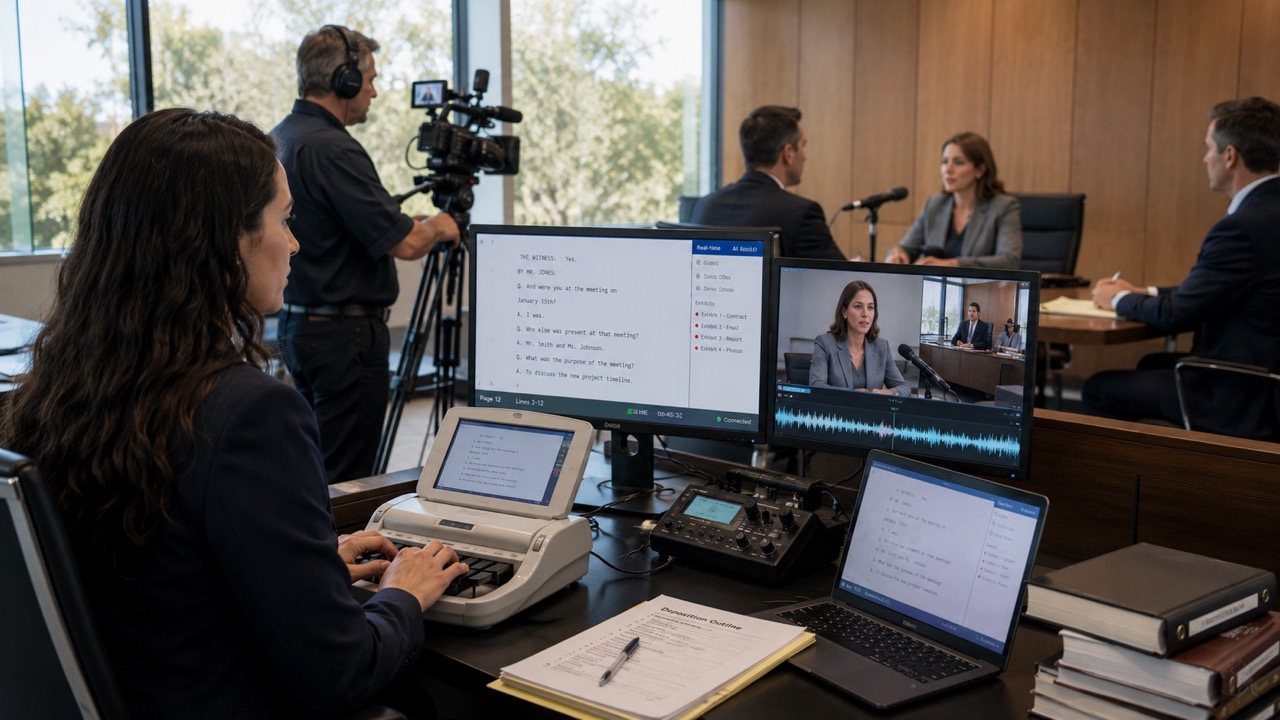
Most people see a court reporter sitting quietly in a courtroom or deposition room. What they do not see is the technology making that quiet work possible. Court reporters rely on a specific set of professional tools to capture, process, and deliver accurate legal records. Each tool serves a precise function. Together, they produce the verbatim transcripts that attorneys, judges, and legal teams depend on every day.
Understanding what court reporters do and the tools they use helps legal professionals choose the right reporting service for their needs. This blog covers every major court reporter tool in use today, from traditional equipment to the AI-powered technology reshaping the field.
The Stenotype Machine
The stenotype machine is the most recognized court reporter tool in existence. It is a compact keyboard device with 22 keys. Court reporters press multiple keys simultaneously to capture syllables, words, and phrases in a phonetic shorthand system. A trained reporter captures speech at speeds exceeding 225 words per minute.
The machine connects to transcription software that translates the shorthand strokes into readable text in real time. This output appears on the reporter’s screen and, in real-time setups, on screens accessible to attorneys during the proceeding.
Stenotype machines are durable, portable, and purpose-built for legal environments. They remain a cornerstone of professional court reporting despite the growth of newer technologies.
Computer-Aided Transcription (CAT) Software
The stenotype machine captures the strokes. CAT software translates them. Computer-aided transcription software converts the phonetic shorthand from the stenotype machine into readable text. Each court reporter builds and refines a personal dictionary within the software over years of practice. That dictionary maps their specific stroke combinations to the correct words and phrases.
CAT software also formats the transcript automatically. Speaker labels, timestamps, question and answer formatting, and line numbering are applied as the reporter works. This reduces post-proceeding editing time and produces a cleaner draft from the start. Modern CAT software integrates with real-time streaming tools so attorneys can follow testimony on a connected device as it is being captured. This is a significant feature in complex depositions and high-stakes trials.
Real-Time Transcription Software
Real-time transcription software takes CAT output and streams it live to connected devices. Attorneys use this tool to read testimony as it is spoken. They see the transcript appear on a laptop or tablet within seconds of each spoken word. This immediate access allows legal teams to flag important moments, draft follow-up questions, and consult with co-counsel without waiting for a formal transcript.
Understanding court reporting at this level helps legal teams make better use of the tools their reporters bring to every proceeding. Real-time access is not a luxury in complex litigation. It is a strategic tool that changes how attorneys respond inside the deposition room.
Digital Audio Recording Equipment
Many court reporters use professional digital audio recorders as a backup to stenographic capture. High-quality microphones placed around the room capture everything spoken during the proceeding. This audio record provides a reference point if any portion of the stenographic record requires verification. In digital reporting setups, audio recording becomes the primary capture method rather than a backup.
Professional audio equipment filters background noise and maintains clear capture even in rooms with challenging acoustics. Court reporters working in large conference rooms, remote settings, or courtrooms with multiple simultaneous speakers rely on quality audio equipment to protect the accuracy of the record.
AI-Powered Speech-to-Text Technology
AI-powered speech-to-text technology is one of the most significant developments in court reporter tools in recent years. This technology converts spoken language into written text automatically using machine learning models trained on legal vocabulary. It processes audio in real time and produces transcript drafts faster than traditional methods.
CourtScribes integrates AI-powered speech-to-text technology into its court reporting services. The AI captures proceedings with high accuracy and delivers drafts quickly. Certified professionals review and certify the output to meet the verbatim standard courts require.
This combination of automation and human oversight produces faster turnaround without sacrificing the accuracy that legal proceedings demand. Certified court reporter services that use AI tools give legal teams the speed of technology with the reliability of professional certification.
Scopists and Editing Software
After a proceeding ends, the rough transcript goes through an editing process. Many court reporters work with scopists, professionals who specialize in editing and refining court reporter transcripts. Scopists use specialized editing software to review the draft, correct any mistranslations, verify proper nouns and legal terminology, and apply consistent formatting.
Editing software used by court reporters and scopists includes tools that flag low-confidence translations from CAT software, highlight words that did not match the reporter’s dictionary, and track every change made during the editing process. The finished transcript goes back to the court reporter for final review and certification before delivery to the legal team.
Video Recording Equipment
Legal videography is a core part of many deposition and trial proceedings. Court reporters often work alongside certified legal videographers who use professional video equipment to capture the full visual record.
High-definition cameras, professional lighting, and clear audio capture witness demeanor, expressions, and nonverbal communication that a written transcript cannot convey. This visual record becomes a critical asset during trial preparation and cross-examination.
Video-to-Text Synchronization Tools
Video-to-text synchronization is one of the most useful court reporter tools available to legal teams today. This technology links each line of the certified transcript to the exact corresponding moment in the video recording. An attorney clicks a transcript line and the video jumps directly to that moment. No manual searching. No scrubbing through footage.
This tool significantly speeds up deposition review, cross-examination preparation, and trial presentation. Legal teams working on complex cases with hours of recorded testimony save substantial time using synchronized transcripts and video.
Secure Online Repositories
Court reporter tools extend beyond the proceeding itself. How transcripts, exhibits, and videos are stored and delivered matters just as much as how they are captured. Secure online repositories give legal teams 24/7 access to all their case files from any device. Transcripts are searchable. Exhibits are organized by case. Videos are stored alongside the corresponding transcripts for easy cross-reference.
CourtScribes provides a private online repository for every client. Legal teams access every file the moment it is uploaded. They do not wait for email delivery or office hours to retrieve a document they need. For law firms managing multiple active cases, this kind of organized, secure, always-available access is an operational advantage that compounds across the entire caseload.
Remote Deposition Platforms
Remote proceedings have become a standard part of legal practice. Court reporters now use professional remote deposition platforms alongside their traditional tools.
Platforms like Zoom integrate with court reporting software to support virtual depositions and hearings. Reporters capture testimony from remote sessions with the same accuracy they bring to in-person proceedings. Speaker identification, exhibit sharing, and real-time transcription all function in remote environments when the right tools and setup are in place.
Finding a court reporter near you now includes options for fully remote service. CourtScribes supports remote depositions and hearings nationwide with professional equipment and experienced reporters trained for virtual proceedings.
Portable Power and Connectivity Equipment
Court reporters work in many different environments. Courtrooms, conference rooms, remote locations, and virtual settings all present different technical challenges.
Portable power supplies, backup batteries, mobile hotspots, and redundant connection equipment protect the reporter’s setup from technical failures during live proceedings. A power interruption or connectivity loss during active testimony can create gaps in the record. Professional court reporters carry backup systems as standard practice. This preparation protects the integrity of the record regardless of the environment.
The Technology Behind Every Accurate Transcript
Every transcript your legal team relies on is the product of multiple court reporter tools working together. The stenotype machine, CAT software, AI-powered transcription, professional audio and video equipment, and secure digital storage all contribute to the final certified record.
Certified court reporters in NYC and across the country use these tools to deliver the verbatim, admissible records that legal proceedings require.
CourtScribes combines all of these tools into a single, integrated court reporting service. AI-powered accuracy, professional legal videography, video-to-text synchronization, remote deposition support, and secure 24/7 access to all case files come standard with every engagement.
Contact CourtScribes today to schedule your next deposition, hearing, or trial proceeding.
 Toll-Free: 833-SCRIBES
 scheduling@courtscribes.com
billing@courtscribes.com