
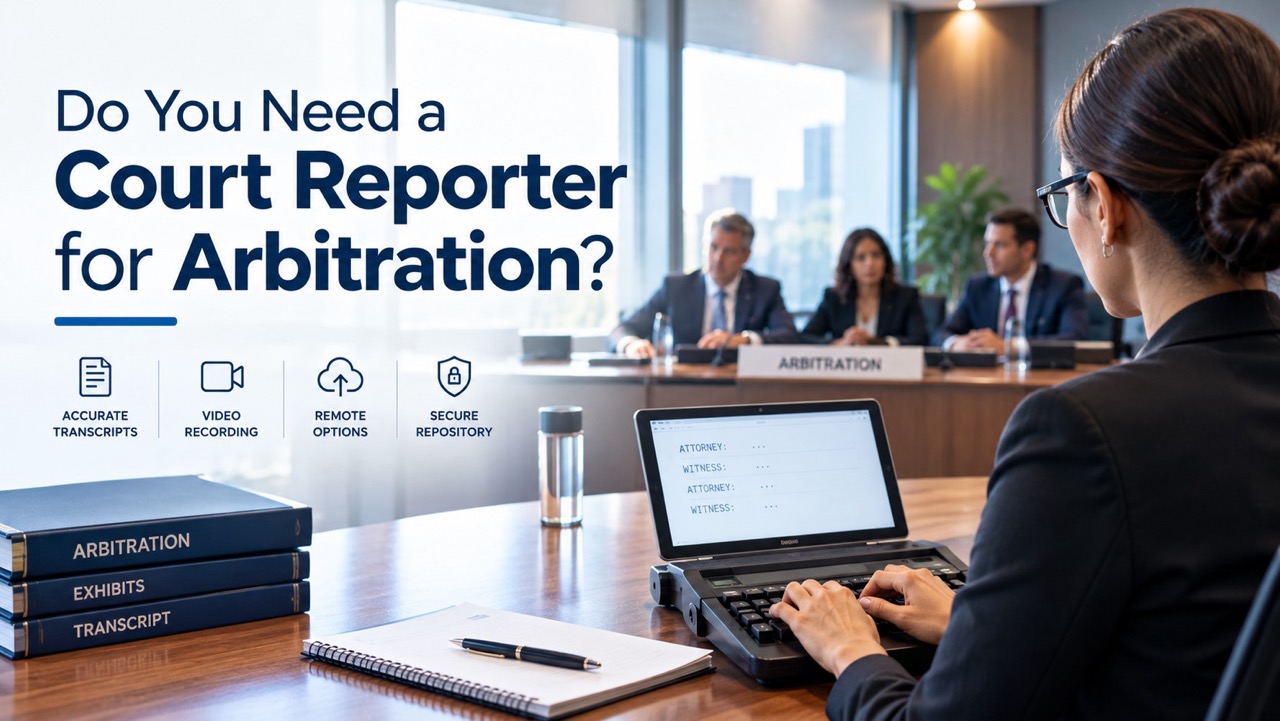
Do You Need a Court Reporter for Arbitration?
Arbitration feels less formal than court. Many parties assume someone will capture every word automatically. In most cases, nobody does. Under the major arbitration rules, the record is your responsibility. If a witness changes their story, you need proof of what they said. If you plan to challenge the award, you need a clear transcript. An arbitration court reporter gives you that proof. This guide explains what the leading forums say about hearing records. It also compares the tools that capture testimony, from stenography to AI-powered digital reporting. By the end, you will know when a reporter adds real value and how to book one.
No Reporter Shows Up Unless You Book One
The American Arbitration Association (AAA) does not supply a court reporter. A party who wants a transcript must arrange it directly. Current AAA Commercial Rule R-29 requires notice to the arbitrator and other parties seven calendar days before the hearing. The requesting party pays, though the arbitrator can settle cost disputes. For expedited cases, the rules state there will generally be no stenographic record. JAMS takes a similar approach. Any party may arrange a stenographic record but must tell the others in advance. If the other parties do not share the cost, the transcript may not reach the arbitrator. The exception applies when the arranging party offers access free or on agreed terms. Check which rule version governs your case.
FINRA Records Audio, but Many Lawyers Want More
Securities disputes at FINRA work differently. Under FINRA Rule 12606, FINRA makes a digital or other recording of every hearing. That recording serves as the official record, even after someone transcribes it. FINRA does not provide a stenographer or a transcript. Any party may still arrange a stenographic record. FINRA’s party guide says to get the panel’s permission first. The audio stays official unless the panel decides otherwise. The party who hires the reporter covers the cost, unless the panel assigns it differently. Many attorneys order a written transcript anyway. Searching text takes minutes. Replaying hours of audio to quote one answer can take far longer when drafting post-hearing briefs.
Recording Tools for Arbitration Hearings
Not every record looks the same. In 2022, the AAA dropped its stenographer-only wording. Its rules now allow any transcribed record or other recording, subject to party agreement or arbitrator approval. That change opened the door to newer technology. An arbitration court reporter can now capture testimony in several ways. Your choice affects accuracy, cost, turnaround, and how easily you use the record later. Some tools capture words. Others capture tone and expression. Here are the main options and where each fits best.
Stenographic Court Reporting
A stenographer types testimony on a shorthand machine as people speak. Software converts the strokes into readable text. Many stenographers offer realtime feeds, so counsel can read testimony on a laptop during the hearing. This helps when you want to quote a witness during cross-examination. Stenographers also mark exhibits and read back answers on request. The main drawbacks are cost and availability. A nationwide reporter shortage makes booking harder in some markets. Daily copy and expedited transcripts add premium fees. For a short hearing with simple testimony, a full stenographic setup can cost more than the dispute justifies.
Digital Court Reporting With Speech-to-Text
Digital court reporting records the hearing with professional audio equipment. Speech-to-text software then produces a draft transcript. Human reviewers check that draft against the audio before delivery. This approach suits arbitration well. Clear audio helps when people talk over each other. The original recording remains available, so anyone can verify a disputed passage. CourtScribes builds its court reporting services around speech-to-text technology and AI-powered court reporting. Accuracy matters here, since transcript errors can damage a case. Under current AAA rules, an audio recording needs party agreement or arbitrator approval. Raise it early in the case.
Legal Videography
Video shows what a transcript cannot. Arbitrators can see a witness hesitate, avoid eye contact, or shift tone. This matters when credibility drives the outcome. CourtScribes offers professional legal videography with video-to-text synchronization. Synced clips let you jump from a transcript line to the matching moment on screen. That saves hours when you prepare closing arguments or post-hearing briefs. A short clip can also refresh the panel’s memory far better than a quoted line. Video does add cost. Videography often costs more than standard court reporting. Get party agreement or the arbitrator’s approval before the hearing begins.
Remote Hearing Platforms
Many arbitrations now run on Zoom or similar platforms. Both AAA and JAMS rules let the arbitrator approve remote testimony. A remote hearing still needs a reliable record. Platform recordings can miss words when connections drop or people speak at once. A professional reporter can join the session and flag audio gaps as they happen. CourtScribes supports remote depositions and remote court appearances for distant witnesses and counsel. The same setup works for pre-hearing depositions. JAMS arbitrators consider deposition testimony when the other parties had a chance to cross-examine.
Secure Online Transcript Repository
A record helps only if your team can find it fast. Paper binders and scattered email attachments slow everyone down. CourtScribes’ Private Online Repository stores transcripts, exhibits, and on-demand videos by case. You can open them on a phone, tablet, or PC. This helps during multi-day hearings when counsel need yesterday’s testimony before the next session. It also simplifies sharing with co-counsel and experts in different offices. Arbitration often involves confidential business information. Ask any provider how it secures files and who can access them. Strong access controls protect both the record and your client’s trust.
Signs Your Case Needs an Arbitration Court Reporter
Arbitration awards are hard to overturn. Under the Federal Arbitration Act, courts vacate awards only on narrow grounds. These include fraud, evident partiality, and certain arbitrator misconduct. Without a record, proving any of those becomes difficult. A transcript also sharpens your advocacy during and after the hearing. Not every case needs one. Certain situations, however, make a reporter worth the cost. Consider booking one if your case involves any of the following:
- High dollar amounts. Large claims justify the expense of a verbatim record.
- Credibility disputes. Exact wording matters when witnesses contradict each other.
- Expert testimony. Technical opinions are hard to recall accurately from notes.
- An optional appeal. JAMS requires a record, if possible, when parties choose its appeal procedure.
- Post-hearing briefs. Page and line citations make your arguments more persuasive.
- A possible court challenge. A record supports motions to vacate or confirm the award.
- Multi-day or remote hearings. Long sessions and video links raise the risk of gaps.
When You Might Skip the Transcript
Some arbitrations do not need a full record. Small claims under expedited procedures often turn on documents and brief testimony. Some arbitrators take detailed notes and rely mostly on exhibits. In those cases, a transcript may cost more than it saves. Still, weigh the risk carefully. You cannot create a record after the hearing ends. If a dispute later arises over a witness’s words, nobody’s notes will settle it. A middle path exists. With party agreement, a digital recording can preserve testimony at a lower upfront cost. You order a full transcript only if the case calls for one. That keeps your options open without paying for pages you may never read.
Your Checklist for Booking an Arbitration Court Reporter
Booking early prevents last-minute problems. Hearings move quickly once scheduled, and skilled reporters fill their calendars fast. Rules also set notice deadlines that can block a late request. The AAA lists the hearing record as a topic for the preliminary hearing. That meeting is the best time to raise it. A short call with your provider covers the rest. Use this checklist before you confirm:
- Read the arbitration clause. Some contracts require a stenographic record or set a cost split.
- Confirm the governing rules. AAA, JAMS, and FINRA each treat the record differently.
- Agree on the official record. Decide whether the transcript, audio, or video controls.
- Meet notice deadlines. Current AAA Commercial Rules require seven calendar days’ notice.
- Settle cost sharing. Decide who pays and whether the award may shift costs.
- Set turnaround times. Ask about daily copy, expedited, and standard delivery.
- Plan for interpreters and exhibits. Flag foreign-language witnesses and large exhibit sets early.
Protect Your Record With CourtScribes
So, do you need a court reporter for arbitration? Most rules leave that choice to you. Yet a record you skip cannot be rebuilt later. For high-stakes or contested hearings, a professional record protects your arguments and your client. An arbitration court reporter from CourtScribes can work in person or join remotely on Zoom. Our team offers AI-powered court reporting, legal videography, live-streaming, and interpreters. Every transcript, exhibit, and video lands in your Private Online Repository, sorted by case. Schedule your arbitration court reporter today. We will help you choose the right recording tools for your hearing.
 Toll-Free: 833-SCRIBES
 scheduling@courtscribes.com
billing@courtscribes.com