
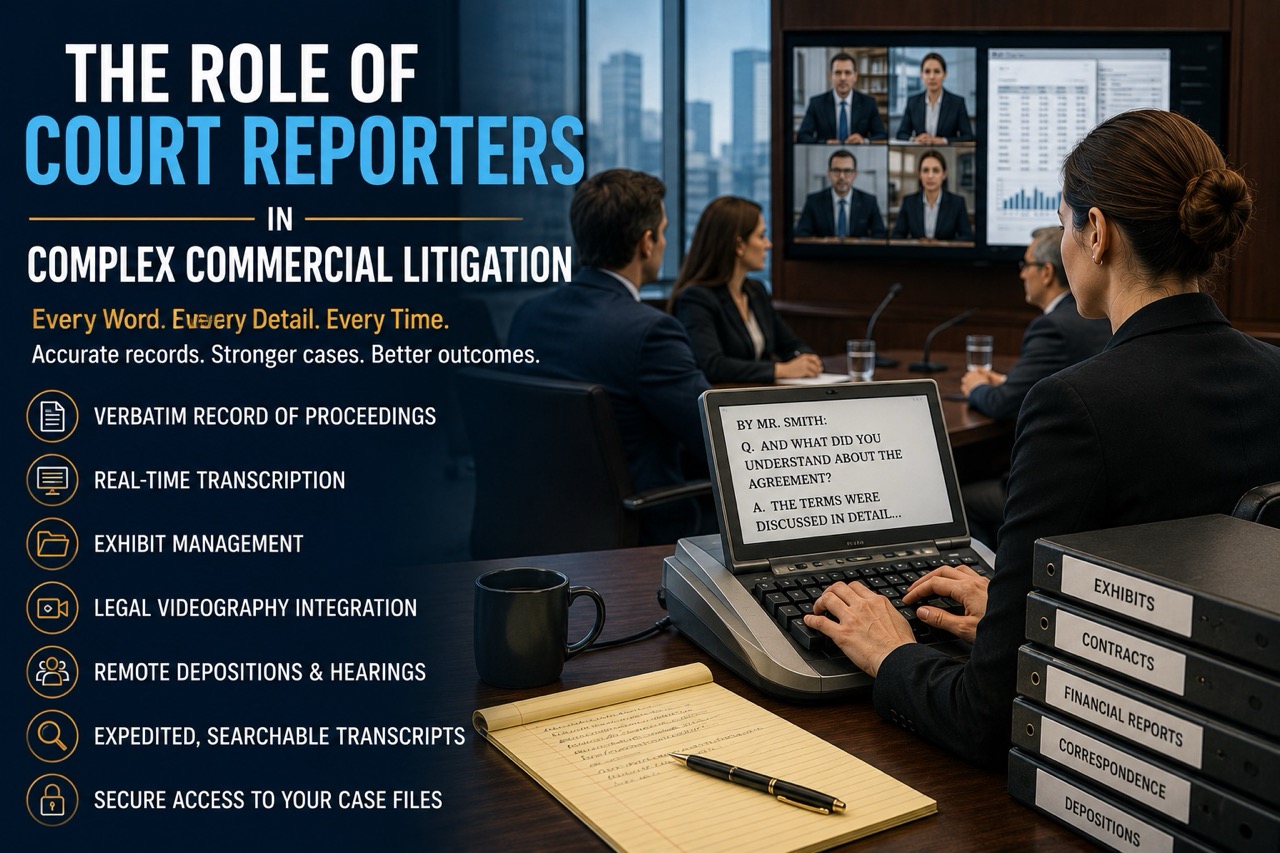
The Role of Court Reporters in Complex Commercial Litigation
Complex commercial litigation involves high-value disputes, extensive documentation, multiple parties, and proceedings that can stretch across months or years. Every word spoken in these cases carries weight. A single inaccurate or missing record can affect motions, appeals, and outcomes.
Court reporters sit at the center of this process. They create the official record, support legal teams in real time, and help keep proceedings moving forward with precision. In this blog, we will cover exactly what court reporters do in complex commercial cases and why their role goes far beyond basic transcription.
Why Accurate Records Matter in Complex Commercial Litigation
In complex commercial litigation, the official transcript is the foundation of every legal argument. Attorneys rely on verbatim records to build motions, prepare cross-examinations, and support appeals. A single gap or error in documentation can create disputes that delay proceedings and weaken a case. Inaccurate records also create risk during arbitration and regulatory proceedings. Accurate court reporting protects the integrity of the entire legal process.
So here is a closer look at the specific roles court reporters play in complex commercial cases.
Court Reporters Create the Official Record of Proceedings
Court reporters capture every word spoken during depositions, hearings, arbitrations, and trial proceedings. They record testimony verbatim and document every objection, ruling, and exchange between counsel.
This verbatim record becomes the legal foundation for everything that follows. Attorneys use transcripts to support future motions, challenge inconsistent testimony, and prepare for appeals. In complex commercial litigation, where proceedings span multiple sessions and involve dozens of witnesses, a reliable and complete record is not optional. It is essential for every stage of the case.
Court Reporters Help Manage High-Volume Depositions
Complex commercial cases regularly involve multi-day and multi-party depositions. Court reporters manage these lengthy sessions while maintaining consistency and accuracy from one session to the next. These cases often require recording testimony from financial experts, corporate executives, and industry specialists who use technical language and complex terminology.
Court reporters capture this testimony accurately regardless of the subject matter. Their ability to stay precise across long, demanding proceedings gives legal teams a complete and reliable record to work from at every stage of litigation.
Court Reporters Support Real-Time Litigation Strategy
Court reporters provide real-time transcription during active proceedings. Attorneys gain immediate access to testimony as it is spoken. This changes how legal teams operate inside the deposition room.
When an attorney can review testimony in real time, they identify inconsistencies faster and follow up with sharper questions. In complex commercial litigation, where witness testimony can shift strategy entirely, this immediate access is a genuine advantage. Court reporters give legal teams the ability to react, adjust, and respond based on what is actually on the record rather than relying on memory.
Court Reporters Assist With Exhibit Management
Exhibit management in complex commercial litigation is a job in itself. Court reporters help legal teams stay organized and in control of the documentary record throughout every proceeding. Here is how they handle two of the most important aspects of exhibit management.
Tracking and Marking Exhibits
Court reporters track and mark every exhibit introduced during a proceeding. They maintain an accurate log that prevents confusion when exhibits are referenced later in the case. Proper marking protects the chain of custody and keeps the record clean for use in motions and at trial.
Organizing Digital Evidence
Modern complex commercial litigation involves large volumes of electronic exhibits. Court reporters help manage digital evidence alongside physical documents. Secure document management ensures that every exhibit is properly stored, accessible, and organized by case for easy retrieval when legal teams need it most.
Court Reporters Facilitate Efficient Transcript Production
Legal teams in complex commercial litigation operate under strict deadlines. Court reporters deliver both standard and expedited transcript services to meet the demands of active litigation timelines. When a motion deadline approaches or a hearing requires immediate preparation, expedited delivery keeps the case on track.
Beyond speed, court reporters produce searchable digital transcripts that legal teams can navigate quickly. Attorneys find specific testimony, locate key statements, and organize case information far more efficiently when transcripts are delivered in a searchable digital format. This saves time and reduces the risk of missing critical details.
Court Reporters Enhance Remote Commercial Litigation
Remote depositions and virtual hearings are now a standard part of complex commercial litigation. Court reporters support these proceedings with the same accuracy they bring to in-person sessions. Multi-location participation creates real challenges. Technical issues, audio quality problems, and overlapping dialogue all threaten the reliability of the record.
Court reporters manage these challenges directly. They maintain an accurate and complete record even when participants join from different cities or countries. Remote proceedings do not reduce the standard. Court reporters ensure the record meets the same level of quality regardless of where the testimony takes place.
Court Reporters Work Alongside Legal Videography Services
A written transcript tells the story of what was said. A video record shows how it was said. Court reporters and legal videographers work together to create a complete litigation record that captures both. In complex commercial litigation, witness credibility often matters as much as the words on the page.
Video preserves tone, hesitation, and demeanor in ways that a transcript cannot. Video-to-text synchronization takes this further by linking specific transcript lines to matching video moments. Legal teams review testimony faster, prepare more targeted cross-examinations, and present evidence more effectively at trial.
Court Reporters Help Protect the Integrity of the Legal Process
Court reporters serve as independent, neutral professionals in every proceeding they attend. They document what happens without bias or interpretation. This neutrality is a critical part of what makes the official record trustworthy and admissible.
Beyond neutrality, court reporters follow strict professional and ethical standards. They meet court requirements for certification and procedural accuracy. In complex commercial litigation, where opposing counsel scrutinizes every element of the record, having a certified and ethically grounded court reporter protects the admissibility of the transcript and supports the integrity of the entire proceeding.
Choosing a Court Reporting Partner for Complex Commercial Cases
The right court reporting partner does more than show up and type. In complex commercial litigation, you need a team that brings technology, experience, and reliability to every session. Here is what to look for.
- Certified Professionals: Choose a service with credentialed court reporters who have direct experience in complex commercial proceedings across multiple industries.
- AI-Powered Technology: Modern court reporting platforms use AI-assisted transcription to improve speed and accuracy without sacrificing quality or human oversight.
- Real-Time Transcription Capability: Real-time access to testimony during live proceedings gives legal teams a strategic edge that traditional methods cannot provide.
- Legal Videography Integration: Look for a partner who coordinates both transcript and video services so your team receives a fully synchronized litigation record.
- Secure Digital Repository: All transcripts, exhibits, and videos should be stored securely and organized by case for immediate access from any device.
- Remote Deposition Support: Your court reporting partner must handle virtual proceedings with the same precision as in-person sessions, including multi-party and multi-location depositions.
- Expedited Delivery Options: Tight litigation deadlines require a partner who can deliver transcripts quickly without sacrificing accuracy or formatting quality.
Court Reporters Are the Backbone of Every Complex Commercial Case
Court reporters do far more than transcribe testimony. They preserve the official record, support case strategy in real time, manage exhibits, facilitate remote proceedings, and provide documentation that legal teams depend on at every stage.
In complex commercial litigation, accuracy and reliability are not negotiable. CourtScribes delivers AI-powered court reporting, professional legal videography, remote deposition support, video-to-text synchronization, and secure online access to all your case files. National coverage means your team gets consistent, high-quality support wherever your case takes you.
Contact CourtScribes today and give your complex commercial litigation the professional support it demands.
 Toll-Free: 833-SCRIBES
 scheduling@courtscribes.com
billing@courtscribes.com