
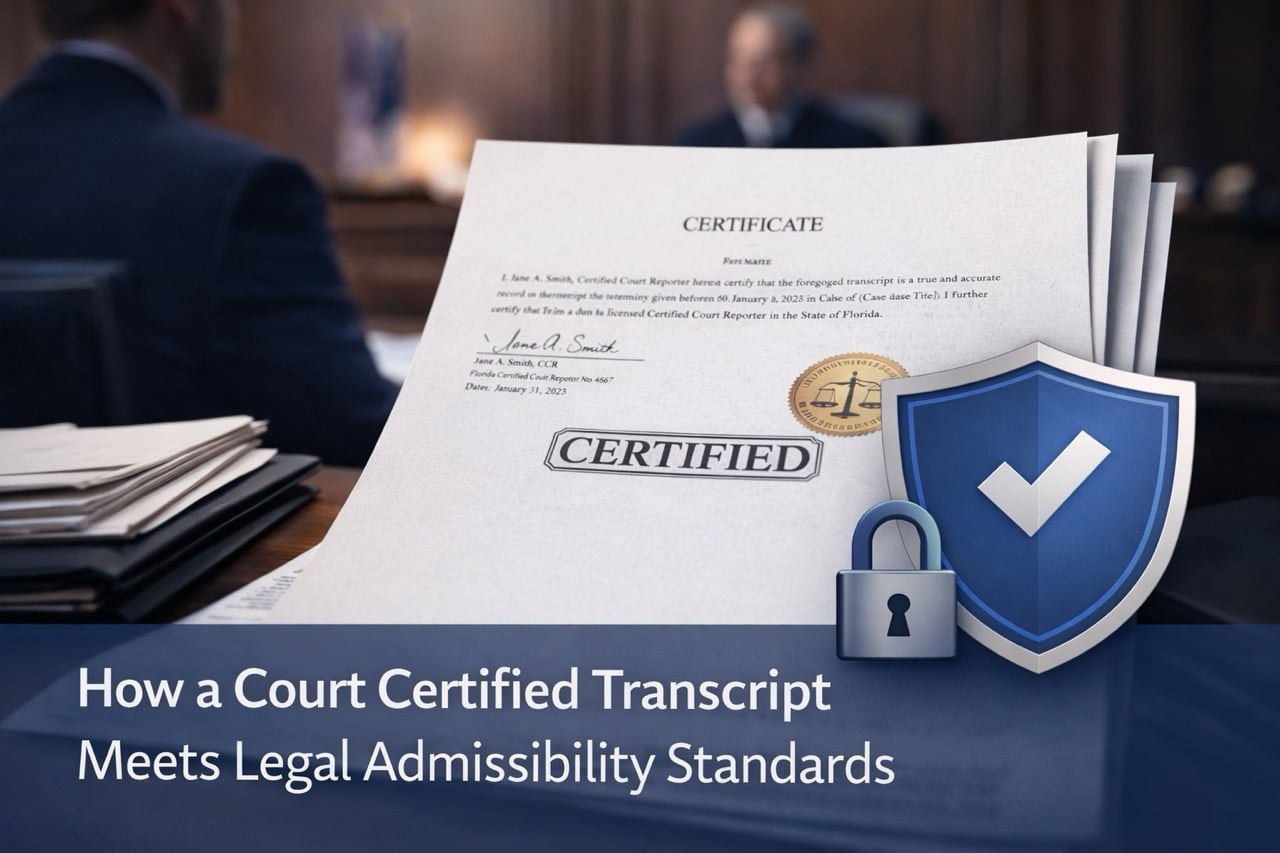
How a Court Certified Transcript Meets Legal Admissibility Standards
Not all transcripts are accepted by courts, even if they appear accurate. A court certified transcript includes official certification from a licensed court reporter verifying accuracy. Draft transcripts lack this professional verification and cannot serve as official legal records.
Court certified transcripts contain certification statements confirming verbatim accuracy and professional responsibility. The certified reporter signs and dates the document attesting to complete accuracy. Additionally, proper formatting follows court requirements for admissibility across all jurisdictions.
Courts require certification for admissibility because it establishes accountability and professional verification standards. Uncertified documents lack authentication that judges demand for evidentiary purposes. Therefore, certification transforms draft transcripts into official legal records.
Why Court Certification Matters in Legal Proceedings
Uncertified transcripts can delay cases, weaken motions, or be rejected by courts outright. Judges refuse to accept documentation lacking proper professional certification and authentication. Missing certification creates procedural problems that disrupt litigation timelines unnecessarily.
Impact on hearings, appeals, and trials becomes significant when transcripts lack proper certification. Appellate courts require certified records for reviewing lower court proceedings and decisions. Additionally, certification protects the official record against challenges about accuracy or completeness.
Judges, clerks, and opposing counsel rely on certification to verify transcript authenticity and accuracy. Professional certification demonstrates that qualified court reporters documented proceedings properly. Furthermore, court certified transcripts prevent evidentiary disputes about testimony content.
Who Is Authorized to Certify a Court Transcript?
Certified court reporters hold exclusive authority to create court certified transcripts under state law. State licensing and national certifications demonstrate professional competence through rigorous testing requirements. Reporters must maintain credentials through continuing education and ethical compliance standards.
Professional certification includes Registered Professional Reporter credentials from the National Court Reporters Association. State-specific licensing adds jurisdictional requirements that vary across different court systems. Additionally, reporters must understand legal procedures and terminology that general transcriptionists lack.
AI or non-certified providers cannot certify transcripts because they lack professional licenses. Courts reject automated transcription without human verification and professional certification. Therefore, only licensed court reporters can create legally admissible court certified transcripts.
Required Elements of a Court-Certified Transcript
Even accurate transcripts fail if required elements are missing from final documentation. Courts enforce specific formatting and certification requirements for admissibility purposes. Missing components prevent acceptance regardless of content accuracy or professional quality.
Mandatory Certification Components
Every court certified transcript must include specific elements that verify professional creation and accuracy:
- Reporter certification statement declares that the transcript accurately represents testimony as recorded
- Signature and date authenticate the document through personal verification by the certified reporter
- Verbatim transcription captures exact words without summarization, interpretation, or editorial changes
- Proper formatting and pagination follow court rules for line numbering and page layout
- Speaker identification clearly attributes all statements to specific individuals throughout proceedings
- No edits or interpretation ensures neutral documentation without bias or professional judgment additions
Missing any component prevents documents from qualifying as court certified transcripts.
How Accuracy Is Verified Before Certification
Human review processes ensure transcripts meet accuracy standards before professional certification occurs. Certified reporters review initial transcription for errors, omissions, and formatting problems. Error correction addresses technical mistakes and unclear testimony sections systematically.
Speaker verification confirms that all statements are attributed to correct individuals throughout proceedings. Multiple quality control steps prevent errors from reaching final certified documentation. Additionally, professional training enables reporters to catch contextual problems that automated systems miss.
Only after complete verification can reporters sign certification statements attesting to accuracy. This verification process separates court certified transcripts from uncertified draft versions completely.
Are AI-Generated Transcripts Court-Certified?
No, AI-generated transcripts are not court certified without human verification by licensed reporters. Automated transcription creates draft documents that require professional review before certification. Courts consistently reject pure AI output lacking professional verification and certification.
AI-assisted transcription helps speed initial processing while reporters verify complete accuracy afterward. This hybrid approach combines technological efficiency with professional certification requirements. However, automation alone cannot produce court certified transcripts that courts accept as evidence.
The difference between draft and certified output lies in professional verification and official certification. AI creates preliminary versions while certified reporters produce final court certified transcripts.
How CourtScribes Delivers Court-Certified Transcripts Nationwide
CourtScribes employs certified court reporters who maintain professional credentials across all jurisdictions. Our digital and human hybrid model combines AI efficiency with required professional certification. Secure online repositories protect court certified transcripts through encrypted storage and access controls.
Remote deposition services enable nationwide testimony collection with identical certification standards everywhere. Legal videography integration captures witness credibility alongside written court certified transcripts. Additionally, professional quality control ensures every transcript meets court admissibility requirements.
Nationwide coverage provides consistent certification standards regardless of case location or complexity. Our certified professionals understand jurisdictional requirements that affect transcript acceptance.
How Attorneys Can Confirm a Transcript Is Court-Certified
Attorneys must verify certification before relying on transcripts for legal proceedings and court filings. Simple questions reveal whether providers deliver authentic court certified transcripts.
Questions to Ask Your Court Reporting Provider:
- Is the reporter certified or licensed under state law and national professional organizations?
- Does the transcript include a certification page with reporter signature and professional attestation?
- Is human verification included or does the service rely on AI-only transcription?
- Is the transcript court-admissible across jurisdictions where you practice regularly?
- How is confidentiality handled throughout transcription, storage, and delivery processes?
These questions protect attorneys from receiving inadequate documentation that courts might reject.
Why Court-Certified Transcripts Protect Your Case
Court certified transcripts avoid objections about documentation authenticity that delay proceedings unnecessarily. Professional certification eliminates evidentiary challenges before they disrupt case strategies. Record integrity remains protected through professional verification and accountability standards.
Appeals and motions depend on certified records that accurately represent lower court proceedings. Appellate courts require court certified transcripts for reviewing judicial decisions and testimony. Additionally, proper certification prevents procedural errors that compromise case outcomes.
Get Court-Certified Transcripts from CourtScribes
CourtScribes provides court certified transcripts through nationwide coverage and certified professionals. Our secure delivery systems protect confidential materials during transmission and storage. Reliable turnaround ensures attorneys receive certified documentation within litigation deadlines.
Professional certification guarantees court acceptance across all jurisdictions nationwide. Contact CourtScribes today for court certified transcripts that protect your cases.
📞 Toll-Free: 833-SCRIBES
📧 scheduling@courtscribes.com
📧 billing@courtscribes.com