
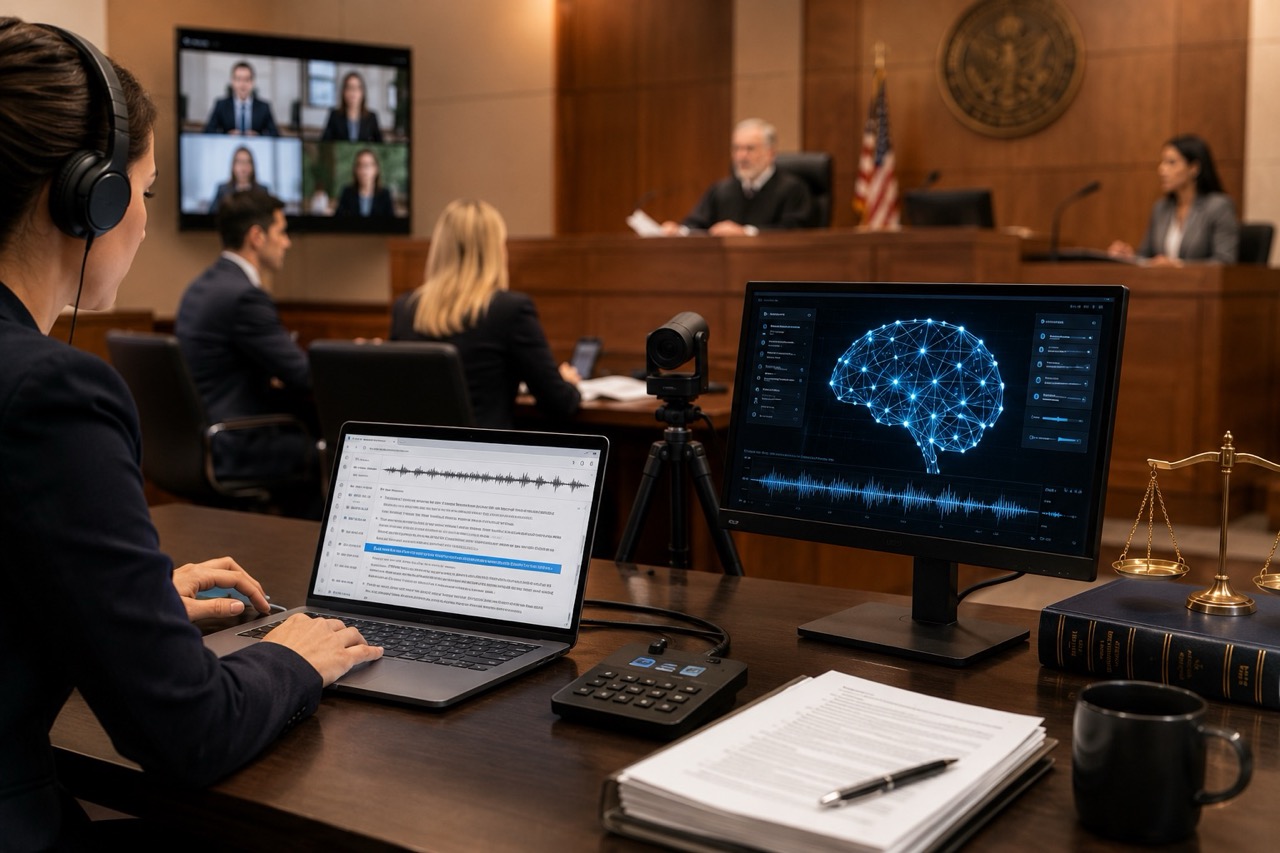
The Biggest Myths About AI Court Reporting
AI court reporting is growing fast. More law firms, attorneys, and legal teams are adopting it across depositions, hearings, and trials nationwide. But alongside that growth comes a lot of misinformation. Some attorneys avoid AI-powered services based on things they have heard that simply are not accurate. Others misunderstand what the technology does and how it works alongside certified professionals. This blog addresses the biggest myths about AI court reporting directly. Each one gets a clear, fact-based response so legal professionals can make informed decisions about the services they choose.
Myth 1: AI Court Reporting Is Not Accurate Enough for Legal Proceedings
This is the most common concern attorneys raise. It is also the most outdated one. Early speech-to-text technology struggled with legal terminology, speaker overlap, and complex audio environments. That was years ago. The technology has improved significantly since then. Modern AI-powered court reporting uses machine learning models trained specifically on legal language. These systems recognize technical terms, case citations, and formal legal dialogue with high accuracy.
Critically, AI court reporting does not operate without human oversight. Certified court reporters review, verify, and certify every transcript before delivery. The AI accelerates the process. The certified professional ensures the final product meets verbatim legal standards. The result is an accurate, admissible transcript produced faster than traditional methods alone.
Myth 2: AI Replaces Human Court Reporters Entirely
This myth causes real concern among legal professionals who value the certified professionals they have worked with for years. AI court reporting does not eliminate human court reporters. It works with them. The technology handles real-time capture and initial transcription. The certified reporter monitors the proceeding, manages the environment, handles exhibits, and reviews the transcript for accuracy. That human expertise cannot be automated.
Understanding court reporting in its modern form means understanding this partnership. AI handles speed and efficiency. The certified professional handles judgment, neutrality, and final certification. Law firms that adopt AI court reporting keep the human expertise they depend on. They simply add a layer of technology that makes the entire process faster and more efficient.
Myth 3: AI Cannot Handle Complex Legal Terminology
Legal proceedings involve specialized language. Medical malpractice cases use clinical terms. Financial litigation involves accounting and regulatory vocabulary. Patent cases rely on technical scientific language. The assumption that AI cannot keep up with this complexity is understandable but incorrect.
AI court reporting systems used in professional legal settings are trained on extensive legal datasets. They handle specialized terminology across practice areas with accuracy. When a term falls outside the system’s dictionary, the human reporter flags and corrects it during review. CourtScribes uses certified court reporter services specifically designed for complex litigation. The combination of AI-powered capture and certified human review handles demanding proceedings across industries and practice areas.
Myth 4: AI Transcripts Are Not Admissible in Court
Some attorneys believe that AI-generated transcripts carry a lower legal standing than traditionally produced ones. This reflects a misunderstanding of how the certification process works. What makes a transcript admissible is not how it was captured. What matters is that it is verbatim, accurate, and certified by a qualified professional.
AI court reporting produces a draft transcript. A certified court reporter reviews that draft, makes any necessary corrections, and certifies the final product. The certification process is the same regardless of whether AI assisted in the initial capture. The certified transcript produced through AI-assisted reporting meets the same admissibility standards as any traditionally produced transcript. Courts across the country accept these records in depositions, hearings, and trials.
Myth 5: AI Court Reporting Cannot Handle Remote Depositions Well
Remote depositions present real technical challenges. Multiple speakers join from different locations. Audio quality varies. Background noise, connection delays, and overlapping dialogue all create difficulties for transcription. The concern that AI struggles in these environments is reasonable. But professional AI court reporting services are built specifically to handle them.
CourtScribes supports remote court appearances via Zoom and other platforms with the same professional standards applied to in-person sessions. The AI processes audio from remote environments efficiently. The certified reporter monitors the session and manages any quality issues in real time. Speaker identification, clear transcript formatting, and accurate capture all remain intact in well-managed remote proceedings.
Myth 6: AI Court Reporting Sacrifices Speed for Accuracy
Some legal professionals assume that if AI is more accurate, it must be slower. Others assume that if it is faster, accuracy must suffer. Neither is correct. This is actually where AI court reporting delivers one of its clearest advantages. Traditional transcription requires the reporter to produce a rough draft after the proceeding ends. Editing and certification follow. Turnaround can take days depending on the length and complexity of the session.
AI-assisted transcription produces a draft in real time during the proceeding. Editing and certification happen faster because the draft is already cleaner. Legal teams receive their certified transcripts significantly sooner. Faster delivery does not mean lower quality. The certification step remains in place. The transcript your team receives is both accurate and delivered on a timeline that keeps your case moving.
Myth 7: AI Court Reporting Is Only for Simple Cases
Another persistent myth is that AI court reporting works for routine depositions but falls short in complex, high-stakes proceedings. The opposite is closer to the truth. Complex cases with lengthy testimony, multiple witnesses, technical subject matter, and large exhibit volumes benefit most from AI-assisted efficiency. Real-time transcription gives attorneys immediate access to testimony during multi-day depositions. Faster turnaround keeps the legal team on schedule when timelines are tight.
Video-to-text synchronization, which links transcript lines directly to matching video footage, becomes especially valuable in complex cases where reviewing hours of testimony would otherwise take significant time. AI court reporting scales to the demands of the case rather than struggling under them.
Myth 8: AI Court Reporting Is Not Secure Enough for Sensitive Legal Matters
Security is a legitimate concern for any legal technology. Case files, witness testimony, and exhibit materials are sensitive. Legal teams have an obligation to protect them. The myth is that AI court reporting platforms are inherently less secure than traditional methods. This ignores how professional services actually handle data protection.
CourtScribes stores all transcripts, exhibits, and video recordings in a private, encrypted online repository. Access is controlled by user permissions assigned by case. Only authorized team members can view the files. This level of security protection matches and in many cases exceeds what is possible with physical documents and email-based file delivery. Legal transcription services built for professional use prioritize data security at every stage.
Myth 9: Switching to AI Court Reporting Is Complicated
Some law firms hesitate because they expect a difficult transition. New technology, new workflows, new training requirements. In practice, the transition is straightforward. AI court reporting services integrate into existing legal workflows without requiring significant changes on the firm’s side. Legal teams schedule their proceedings the same way. They receive transcripts through a secure platform organized by case. They access files from any device at any time.
CourtScribes handles the technology setup and delivery. The legal team experiences a faster, more organized process. The learning curve is minimal and the operational improvement is immediate.
Myth 10: AI Court Reporting Costs More Than Traditional Services
The assumption that advanced technology automatically means higher cost does not hold up in this context. AI-assisted transcription reduces the time required for post-proceeding editing and production. That efficiency passes through to the service. Legal videography, which is typically one of the more expensive components of deposition documentation, is offered by CourtScribes at rates designed to be cost-effective for legal teams of all sizes.
When legal teams also factor in the value of faster turnaround, 24/7 secure access, and synchronized video transcripts, the overall value of AI court reporting becomes clear. The question is not whether it costs more. The question is what the alternatives actually cost when you account for delays, inefficiencies, and missed deadlines.
The Truth About AI Court Reporting
AI court reporting is accurate, certified, secure, and built for the full range of legal proceedings. The myths that surround it stem from outdated assumptions about early technology or misunderstandings about how modern services actually work.
Legal teams that move past these myths gain access to faster transcripts, better-organized case files, real-time testimony access, and professional video records synchronized with certified text. CourtScribes delivers all of this through a single, integrated service backed by certified professionals and national coverage.
Schedule your next proceeding with CourtScribes and experience AI court reporting the way it was designed to work.
 Toll-Free: 833-SCRIBES
 scheduling@courtscribes.com
billing@courtscribes.com