
Remote Deposition Videographer Services Nationwide | CourtScribes
The hardest part of capturing a legally usable video record of a deposition has never been finding a camera. It has been controlling the environment. In an in-person deposition suite, a professional videographer manages the room: lighting, acoustics, camera angles, exhibit presentation, and the precise framing that makes a witness’s testimony compelling at trial. In a remote deposition conducted over Zoom, Microsoft Teams, or WebEx, none of those conditions are guaranteed. The witness might be in a home office with a window glaring behind them. Audio might cut in and out. The platform recording compresses the video into a format that looks serviceable until someone tries to play it for a jury.
This is the pain point that professional legal videography solves. It is the reason more litigation teams are choosing CourtScribes for their video deposition services rather than relying on whatever the conferencing platform records by default.
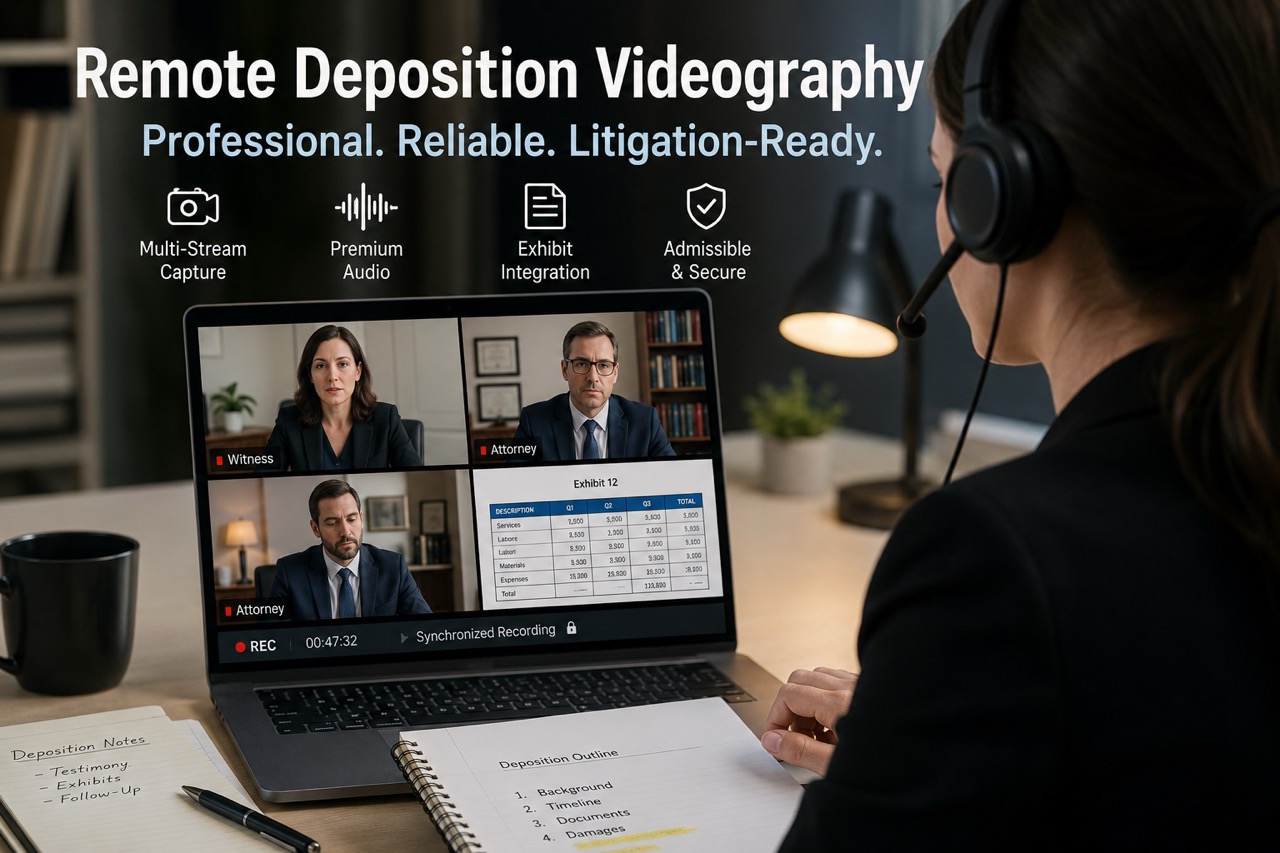
CourtScribes delivers remote deposition videography that meets litigation-grade standards across every major platform, with multi-stream capture, synchronized audio, exhibit integration, and a final video record that holds up to the scrutiny of opposing counsel, the court, and the jury box.
Why Platform Recordings Are Not Enough
When an attorney schedules a Zoom deposition and hits the built-in record button, the resulting file is a platform recording. It is not a legal video deposition. The difference is significant. Platform recordings are engineered for meeting convenience, not litigation admissibility. They use compressed video codecs that degrade image quality. Speaker views shift automatically based on who is talking, which means the camera cuts away from a witness at the exact moment a critical non-verbal reaction occurs. Audio is processed by the platform’s noise suppression algorithms, which can muffle words, cut syllables, or create artifacts during overlapping speech. The resulting file has no chain of custody documentation, no officer’s opening statement as required under Federal Rule of Civil Procedure 30(b)(5), and no guarantee that the recording captures what it needs to capture for trial use.
Courts have increasingly scrutinized the admissibility of platform-only recordings. The U.S. District Court for the Middle District of Florida Civil Discovery Handbook specifically notes that parties recording a deposition only by video must understand that a transcript will be required under Rules 26(a)(3)(A)(ii) and 32(c) if the deposition is later offered as evidence at trial, and directs parties to Rule 30(b) of the Federal Rules of Civil Procedure as published by the U.S. Courts for the specific procedures that ensure proper recording.
Platform recordings can have compressed audio, shifting speaker views, and limited control over what appears on screen. When the goal includes trial playback, many litigation teams choose a separate video recording managed by a legal videographer, even when the proceeding is remote. Professional remote deposition videography from CourtScribes addresses every one of these deficiencies before the deposition begins, not after a problem surfaces in the courtroom.
How CourtScribes Remote Deposition Videography Works
Successful remote deposition videography depends on more than recording a video conference. CourtScribes combines professional capture technology, technical oversight, and litigation-focused workflows to produce reliable, high-quality video records that support discovery, trial preparation, and courtroom presentation across every major remote conferencing platform.
Multi-Stream Capture Across Every Platform
CourtScribes engineers remote deposition videography to work across Zoom, Microsoft Teams, WebEx, and other major conferencing platforms without requiring any special software installation on the part of the witness or opposing counsel. Our technical team connects to the proceeding using a dedicated capture setup that records multiple streams simultaneously.
The witness feed is captured in a dedicated high-resolution stream. Counsel feeds are captured separately. The exhibit share is captured as a synchronized screen stream. These independent recordings are then combined in post-processing into a synchronized multi-view video record, giving trial teams the flexibility to present any angle, cut between speakers, and zoom into exhibit detail without relying on the platform’s automatic camera switching. This multi-stream approach is what separates our remote deposition videography from anything a conferencing platform can produce on its own.
Audio Synchronization for a Clean Record
Audio is the single most common failure point in remote video deposition records. CourtScribes captures audio independently from the platform’s compressed audio stream, using a dedicated audio bridge that records each participant’s input separately before mixing. This means that even if the platform audio degrades, the backup audio track is clean and synchronized to the video frame by frame.
For a legal video deposition service that will be used at trial, this audio precision is not optional. Federal Rule of Civil Procedure 30(b)(3)(A) requires the party noticing the deposition to state the method for recording the testimony and specifies that the deponent’s and attorneys’ appearance or demeanor must not be distorted through recording techniques. An audio track that drops syllables or compresses voice quality raises evidentiary objections that a clean, independently captured audio feed eliminates entirely.
Exhibit Visibility in a Remote Environment
Exhibits are among the most technically difficult elements of any remote video deposition. Attorneys share documents on screen, witnesses annotate them, and counsel zooms in and out. A platform recording captures whatever appears in the screen share at that moment, often in a compressed format that makes text illegible in the final recording.
CourtScribes captures the exhibit feed as a dedicated high-resolution stream, separate from the speaker feeds. Every document shared during the deposition is recorded in full resolution so that text, tables, photographs, and annotations are clearly legible in the final video. When trial counsel needs to play back a moment where the witness was confronted with a specific document, the jury can read every word on the screen.
We also coordinate with your team before the deposition to establish an exhibit sharing protocol that ensures clean capture of every document, whether exhibits are shared through the platform screen share, a dedicated exhibit repository, or a hybrid approach using both digital and physical copies. The Office of Justice Programs has published analysis of how video records function within federal evidentiary frameworks, including how exhibit presentation affects jury reception of video deposition testimony at trial.
Admissibility: What Attorneys Need to Know
The admissibility of remote video deposition recordings is governed by a framework that has evolved significantly since 2020. Amendments to the Federal Rules effective in December 2024 reaffirmed the availability of remote proceedings, but courts continue to issue local rules and standing orders that supplement the federal framework, requiring attorneys to review both the federal text and jurisdiction-specific guidelines before each proceeding.
A video deposition offers an opportunity to personify a witness who cannot appear at trial. It can be used to demonstrate events or conduct that cannot be reconstructed in the courtroom and to enhance the use of exhibits. But that opportunity is only available if the video record was captured correctly in the first place.
CourtScribes remote deposition videography is structured to satisfy all applicable procedural requirements, including the officer’s on-camera opening statement, the administration of the oath on camera, a closing statement confirming the deposition’s end, and full documentation of all persons present. These procedural steps, required under FRCP Rule 30(b)(5), are completed as part of every proceeding our team handles.
The Cost Advantage of Remote Video Deposition Services
One of the most underappreciated benefits of professional remote deposition videography is the scheduling and cost efficiency it creates. Traditional in-person deposition videography requires travel time and expenses for the videographer, setup time at the deposition venue, and coordination with a physical space that can accommodate professional equipment. Remote video depositions eliminate every one of those variables.
A Zoom deposition recording with CourtScribes can be scheduled faster, confirmed more easily, and conducted without any geographic constraint. A witness in Seattle, an expert in Boston, and counsel in Miami can participate in a fully certified remote video deposition with litigation-grade video without anyone boarding a plane. The cost savings on travel alone frequently exceed the entire cost of the videography service, and that calculation does not include the time value of senior attorneys spending a day in transit instead of at their desk.
Attorneys planning remote proceedings can learn more about the scheduling process through our remote depositions services, while those comparing providers often review our legal video service pricing to better understand the cost advantages of remote litigation support. CourtScribes delivers professional video deposition services at rates typically 30 to 50 percent lower than traditional legal video agencies without compromising recording quality or reliability.
What CourtScribes Remote Deposition Videography Includes
A successful remote deposition demands far more than pushing record. CourtScribes delivers a complete litigation focused videography service designed to give legal teams an unquestionable, courtroom ready video record. By combining pre proceeding technical prep, professional multi stream capture, and strict procedural compliance, we eliminate technical distractions so attorneys can focus entirely on their witness.
Our comprehensive remote solution covers every phase of the proceeding. From pre deposition tech checks with all participants to frame accurate audio recording and synchronized exhibit capture, we ensure complete accuracy throughout. We strictly adhere to Federal Rules of Civil Procedure guidelines, handle sworn statements seamlessly, and maintain precise chain of custody documentation for trial admissibility. Once off the record, your media is processed and uploaded to our private, secure repository. CourtScribes clients enjoy complimentary 24/7 access to their entire case archive including high definition video, transcripts, and stamped exhibits from any device, anytime.
- Pre-deposition technical coordination. Our team contacts all participants before the deposition to confirm platform access, test audio and video feeds, establish the exhibit sharing protocol, and resolve any technical issues before the proceeding goes on the record. Attorneys do not troubleshoot on the record with CourtScribes.
- Multi-stream synchronized recording. Independent capture of the witness feed, counsel feed, and exhibit share, synchronized by timecode across all streams.
- Independent audio capture. Dedicated audio recording separate from the platform’s compressed audio, synchronized to video frame by frame.
- Exhibit integration. High-resolution capture of every document shared during the proceeding, with exhibit stamps and synchronized timecode for reference in post-production.
- FRCP-compliant officer procedure. Full on-camera opening statement, administration of oath, identification of all persons present, and closing statement as required under Rule 30(b)(5).
- Chain of custody documentation. Full documentation of the recording process for admissibility purposes.
- Secure delivery. Final video delivered through our private online repository, accessible 24/7 from any device, organized by case and proceeding. Every CourtScribes client receives free access to their full case archive, including transcripts, exhibits, and videos, at no additional charge.

Video-to-Text Synchronization for Trial Preparation
Recording a remote deposition is only the beginning of creating a useful litigation resource. CourtScribes enhances every professionally recorded proceeding with video-to-text synchronization, connecting each word of the certified deposition transcript to the exact moment it appears in the video. Instead of manually searching through lengthy recordings, attorneys can select any word or phrase in the transcript and immediately view the corresponding testimony. This streamlined workflow significantly reduces review time during discovery, witness preparation, motion practice, and trial planning.
For matters involving multiple witnesses or numerous deposition recordings, synchronized video allows legal teams to organize testimony efficiently and prepare precise impeachment or presentation clips without repeatedly scanning hours of footage. Because our certified court reporting and remote videography services work together within the same workflow, transcripts and synchronized recordings remain organized in one secure case archive. The result is a consistent litigation resource that simplifies case preparation while giving attorneys immediate access to accurate testimony whenever it is needed.
Platforms We Support for Remote Deposition Videography
CourtScribes provides remote deposition videography across the major video conferencing platforms used by law firms, corporations, government agencies, and expert witnesses. Our recording process is designed to work with Zoom, Microsoft Teams, Webex, and other widely used conferencing systems without requiring complicated software installation for participants. Regardless of the platform selected, our technical team applies the same litigation-focused workflow to produce consistent, high-quality recordings suitable for legal proceedings.
Zoom remains one of the most common platforms for civil litigation, while Microsoft Teams is frequently preferred by organizations using Microsoft 365. Webex continues to serve many government agencies, corporate legal departments, and institutional clients. CourtScribes also supports additional conferencing platforms whenever compatible with our professional recording workflow. Before each proceeding, our technical team verifies platform compatibility, recording requirements, participant access, and exhibit-sharing procedures to help ensure every remote deposition proceeds smoothly without unnecessary technical interruptions or delays.
How Remote Deposition Videography Fits the CourtScribes Ecosystem
Remote deposition videography is one part of the broader litigation support solutions provided by CourtScribes. While many matters require only professionally recorded depositions, others continue through hearings, arbitrations, mediations, and courtroom trials that benefit from the same consistent recording standards. For that reason, many firms combine remote deposition videography with our legal videography services to maintain continuity throughout every stage of litigation instead of coordinating multiple providers.
As cases progress toward trial, attorneys often expand their video strategy by incorporating courtroom videography for in-court proceedings or litigation support videography for matters involving multiple witnesses, locations, or extended case timelines. Some trial teams also rely on secure live-streaming so authorized attorneys, consultants, or clients can follow proceedings remotely. Whether a case involves a single deposition or months of coordinated litigation, CourtScribes provides integrated legal video solutions that help firms maintain organized records, consistent production quality, and dependable support from discovery through final resolution.
FAQs About Remote Deposition Videography
Q1. What is remote deposition videography, and how is it different from a platform recording?
Remote deposition videography is a professionally managed legal recording that includes high-quality audio, video, exhibit capture, and documented procedures. Unlike a basic meeting recording, it is prepared for litigation use.
Q2. Which platforms does CourtScribes support for remote deposition videography?
CourtScribes supports Zoom, Microsoft Teams, Webex, and most major video conferencing platforms. Our platform-independent recording process works without requiring special software, host access, or complicated participant setup.
Q3. Are remotely recorded video depositions admissible in federal court?
Yes. When conducted in accordance with applicable federal procedural rules, remotely recorded depositions may be admissible. CourtScribes follows established recording procedures to support compliance throughout every proceeding.
Q4. How are exhibits recorded during a remote video deposition?
CourtScribes captures exhibits in high resolution alongside participant video feeds, preserving document clarity. Our team also coordinates exhibit-sharing procedures before the deposition to maintain consistent recording quality.
Q5. Can CourtScribes provide video-to-text synchronization for remote deposition videos?
Yes. CourtScribes provides video-to-text synchronization that connects certified transcript text with corresponding video timestamps, allowing attorneys to instantly locate testimony during case preparation, review, and trial presentation.
Q6. Does CourtScribes provide certified court reporters with remote videography services?
Yes. CourtScribes offers remote deposition videography as a standalone service or alongside certified court reporting, allowing legal teams to schedule complete deposition services through one experienced provider.
Q7. How quickly can I schedule remote deposition videography?
CourtScribes accepts scheduling requests 24/7, including same-day and next-day appointments when available. Remote proceedings eliminate travel requirements, making scheduling faster and more flexible for litigation teams.
Schedule Remote Deposition Videography with CourtScribes
A remote deposition is not a lesser proceeding. It is a full evidentiary event that may determine the outcome of a case worth millions of dollars, shape the expert testimony your jury hears, or preserve the only opportunity to examine a witness who will not be available at trial. The video record of that proceeding deserves the same professional standard as anything captured in a deposition suite downtown.
CourtScribes delivers remote deposition videography that meets that standard every time, on every platform, for every type of legal matter. When the environment is out of your control, our technology and expertise put the quality of your video record back in your hands. Schedule your remote deposition videography with CourtScribes today.
Call Us
Toll Free: 833-SCRIBES
Email Us
Scheduling: scheduling@courtscribes.com
Billing: billing@courtscribes.com