
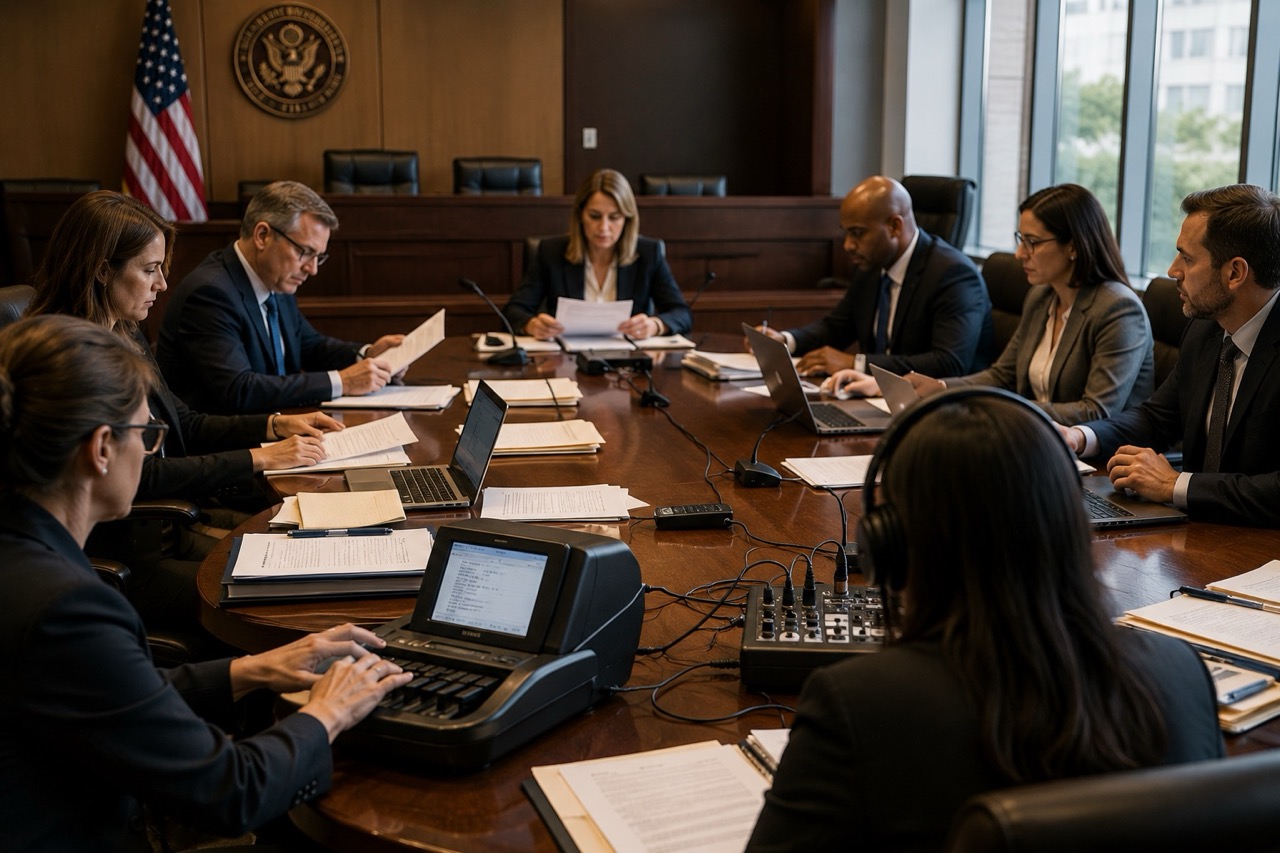
Federal Panel Reviews Depositions in Criminal Cases
Federal criminal procedure may be on the verge of a significant shift. A federal advisory committee is now weighing something the federal criminal system has resisted for more than 80 years: allowing parties to take pretrial depositions in criminal cases. This discussion affects attorneys, prosecutors, defense teams, witnesses, and court reporting professionals across the country.
If criminal depositions expand at the federal level, the ripple effects will be substantial. Transcript accuracy, legal videography, remote proceedings, and evidence management will all face new demands. Legal professionals need to understand what is being proposed and what it could mean for how cases are handled going forward.
What Is Driving the Federal Push for Criminal Depositions
The federal advisory committee on criminal rules is considering revisions to Federal Rule of Criminal Procedure 15 to permit depositions in criminal cases. The issue has been placed on the advisory committee’s study agenda, and a subcommittee will be formed to study it.
Currently, criminal cases in federal court operate very differently from civil cases. Rule 15 permits depositions in criminal cases only for the limited purpose of preserving testimony for trial. Civil litigants can depose witnesses freely during pretrial discovery. Criminal defendants cannot.
One leading reform proposal would revise Rule 15 to permit up to five pretrial depositions in federal criminal cases, subject to judicial approval, with judges retaining discretion to permit more in exceptional circumstances. Proponents argue this addresses a fundamental fairness issue. Roughly 20 states already permit some form of pretrial deposition in criminal cases. Florida, Missouri, Indiana, Iowa, Vermont, and New Hampshire are among the states with broader deposition rights in felony cases.
How Criminal Depositions Could Change Legal Proceedings
As federal discussions continue, many legal professionals are asking how expanded criminal depositions could affect real-world litigation. The answer goes beyond procedure alone. These potential changes could impact case preparation, witness testimony, evidence handling, and courtroom strategy across multiple stages of a criminal matter.
Several areas of the legal process could see major operational changes if criminal depositions become more widely permitted.
More Detailed Pretrial Discovery
Attorneys could gather sworn testimony well before trial begins. Defense counsel would gain direct access to witness statements earlier, allowing both sides to assess case strength and make better-informed decisions about plea offers or trial strategy.
Increased Demand for Accurate Transcript Documentation
Every criminal deposition would require a verbatim record. The demand for reliable, accurate transcripts would grow significantly. AI-powered court reporting and real-time speech-to-text technology would play a central role in meeting that demand efficiently.
Expanded Use of Legal Videography
Video records would become more valuable in criminal proceedings than ever before. Capturing witness demeanor, tone, and nonverbal reactions during testimony adds critical context. A video record of a deposition can also preserve testimony for use at trial when witnesses are unavailable.
Greater Reliance on Remote Deposition Technology
Multi-party criminal cases involve witnesses, attorneys, and participants across different locations. Remote deposition platforms and Zoom-based proceedings would become increasingly important for managing scheduling, accessibility, and efficiency in expanded criminal discovery.
Challenges and Concerns Surrounding Criminal Depositions
Expanding criminal depositions is not without opposition. Several serious concerns have been raised by critics of the proposed changes. Federal criminal cases include violent crimes, organized crime, narcotics conspiracies, and gang prosecutions in which witnesses face real risks. Some worry that depositions create opportunities for intimidation, coercion, and tampering. Witness safety is a significant and legitimate concern in these environments.
Adding deposition practice would also extend pretrial timelines and impose costs for court reporters, transcripts, and counsel time. Courts already managing heavy caseloads would face increased administrative burden.
Constitutional questions also arise. The Sixth Amendment right to confront witnesses must be carefully considered when determining how deposition testimony may be used at trial. Secure and organized evidence management systems would become essential for handling the increased volume of records and protecting sensitive case data.
Technology Could Play a Larger Role in Criminal Depositions
Modern litigation already depends heavily on digital tools, especially in complex and remote proceedings. If criminal depositions expand, technology may become essential for maintaining efficiency, organization, and accuracy throughout the legal process.
Several legal technologies could become increasingly important in future criminal deposition workflows:
- AI-powered court reporting for fast, verbatim transcript production
- Real-time speech-to-text transcription to capture testimony instantly during proceedings
- Remote deposition platforms to support multi-party sessions across locations
- Secure online repositories for storing exhibits, transcripts, and video recordings by case
- Video-to-text synchronization tools to connect testimony with matching footage
- Digital evidence sharing systems for organized, protected exchange between legal teams
Why Accurate Court Reporting Matters in Criminal Proceedings
In criminal cases, the stakes attached to every word of testimony are extraordinarily high. A verbatim transcript is not just a convenience. It is the foundation of the legal record. Incomplete or delayed records create gaps that opposing counsel can exploit. Synchronized video and transcript access lets attorneys review exactly what was said and how it was delivered.
Reliable court reporting services help legal teams manage complex, multi-party proceedings without losing accuracy or organization. In criminal litigation, where liberty is at stake, there is no acceptable margin for error in documentation.
How CourtScribes Supports Modern Legal Proceedings
CourtScribes delivers the tools that legal professionals need as litigation standards continue to evolve. AI-powered court reporting captures verbatim records accurately and efficiently, even in complex or multi-party proceedings. Remote court appearances via Zoom keep depositions and hearings moving regardless of participant location.
Professional legal videography creates a complete visual record that adds critical context to witness testimony. Video-to-text synchronization connects footage directly to transcript lines for faster and more precise case review.
A secure private online repository stores all transcripts, exhibits, and videos organized by case. Legal teams across the country rely on CourtScribes for consistent, high-quality litigation support.
Criminal Depositions Are Evolving. Your Preparation Should Too.
The full rule amendment process typically takes several years, but the foundation for a serious federal conversation about criminal depositions has now been laid. Legal professionals who prepare now will be better positioned when procedural standards shift.
Accuracy, technology, and efficient documentation will define how well legal teams navigate these changes. CourtScribes is ready to support your practice at every stage.
Schedule your next proceeding with CourtScribes today.
Toll-Free: 833-SCRIBES
 scheduling@courtscribes.com
billing@courtscribes.com