
Remote Depositions vs. In-Person Depositions: Which Is Better for Your Case?
Attorneys face critical decisions about deposition formats that significantly impact case outcomes and litigation costs. Remote depositions offer convenience while in-person proceedings provide traditional control and physical presence. Both formats serve important purposes in modern legal practice.
Choosing the wrong format can increase costs, delay cases, or affect testimony quality negatively. Virtual depositions reduce travel expenses but may complicate complex exhibit presentations. Additionally, in-person proceedings enable direct witness observation but require extensive scheduling coordination.
The remote vs in-person depositions debate depends on specific case requirements and strategic objectives. CourtScribes provides neutral, full-service support for both formats with nationwide coverage and professional expertise. Our comprehensive services help attorneys select optimal deposition formats based on case needs.
Understanding the Difference Between Remote and In-Person Depositions
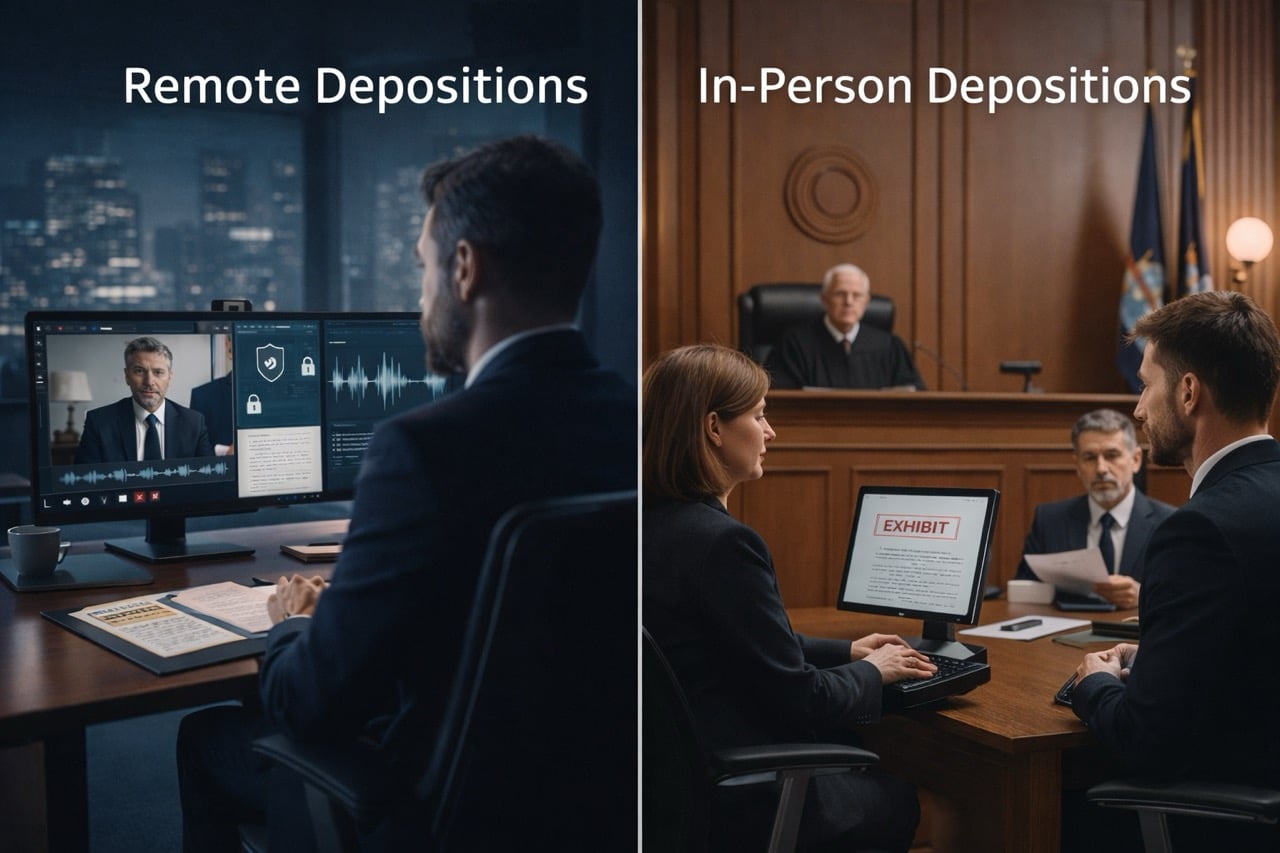
Remote depositions conduct witness testimony through secure video conferencing platforms from separate locations. Participants join virtual proceedings from offices, homes, or other convenient locations nationwide. Professional court reporters create official transcripts while legal videographers capture testimony remotely.
In-person depositions gather all participants in a single physical location for face-to-face testimony. Traditional proceedings occur in law offices, court reporter facilities, or other professional spaces. Court reporters document testimony using stenography while videographers may record visual evidence.
Both formats follow identical legal standards for accuracy, confidentiality, and admissibility under federal rules. Courts accept testimony from remote vs in-person depositions equally when proper procedures are followed. Additionally, certified court reporters ensure transcript quality regardless of deposition format chosen.
When Remote Depositions Make Sense for Your Case
Travel delays and scheduling conflicts slow litigation progress and increase costs unnecessarily. Remote depositions eliminate geographic barriers that complicate witness availability and coordination. Virtual proceedings accelerate case timelines while reducing expenses associated with traditional depositions.
Remote deposition services provide significant advantages for specific case situations:
- Out-of-state witnesses participate without expensive travel or extended absence from work responsibilities
- Tight litigation timelines benefit from flexible scheduling that accommodates multiple time zones
- Budget-sensitive cases reduce costs by eliminating travel, venue rental, and accommodation expenses
- Health or travel limitations enable participation from individuals unable to attend physical locations
Virtual testimony maintains professional standards while providing convenience that traditional proceedings cannot match. Online depositions support efficient case progression without compromising documentation quality or legal requirements.
When In-Person Depositions Are the Better Choice
Some testimony requires physical presence for clarity and control during critical case moments. Complex technical demonstrations need hands-on exhibit interaction that virtual platforms cannot replicate effectively. High-stakes witness credibility assessments benefit from direct observation in controlled environments.
In-person depositions excel when cases involve intricate physical evidence requiring detailed examination. Multi-party proceedings with numerous attorneys benefit from face-to-face coordination and communication. Additionally, hostile witnesses may require the formality and control that physical presence provides.
Technical matters involving blueprints, machinery, or physical products need direct interaction and examination. Sensitive testimony sometimes demands the psychological impact of formal courtroom-style settings. Furthermore, remote vs in-person depositions favor traditional formats when technology limitations could compromise proceedings. Attorney control and witness management often improve significantly in physical deposition settings.
Comparing Cost, Scheduling, and Efficiency
| Factor | Remote Depositions | In-Person Depositions |
|---|---|---|
| Travel Costs | Eliminated completely | Attorney and witness travel required |
| Scheduling Flexibility | High – accommodates multiple time zones | Limited by travel and venue availability |
| Venue Expenses | None required | Conference room rental fees |
| Time Efficiency | Faster scheduling, no travel time | Requires coordination and travel days |
| Geographic Reach | Nationwide witness access | Limited by practical travel distance |
| Technology Requirements | Moderate investment needed | Minimal beyond recording equipment |
The remote vs in-person depositions cost analysis clearly favors virtual proceedings for budget efficiency.
Accuracy and Record Integrity in Both Formats
Poor audio or unverified transcripts can jeopardize admissibility regardless of deposition format chosen. Professional court reporting maintains identical accuracy standards for remote and in-person proceedings. Certified court reporters ensure transcript quality through professional training and ethical obligations.
Human verification catches contextual errors that AI-only tools miss during automated transcription processes. Professional oversight ensures proper speaker identification and testimony clarification throughout proceedings. Additionally, certified transcripts meet court admissibility requirements across all jurisdictions equally.
Remote vs in-person depositions both require professional documentation that protects case integrity completely. Transcript standards remain consistent regardless of participant locations or technology platforms used.
Technology and Security Considerations
Secure platforms protect confidential testimony through encryption during transmission and storage phases. Professional deposition technology includes access controls that limit participation to authorized individuals. Chain of custody documentation maintains evidence integrity for both remote and traditional proceedings. Encrypted storage prevents unauthorized access to sensitive case materials and privileged communications. Remote vs in-person depositions both benefit from professional security measures throughout documentation processes.
What Law Firms Should Expect from Deposition Technology
Professional deposition providers should offer comprehensive technology features that protect case materials:
- Encrypted connections secure video and audio transmission preventing interception during live proceedings
- Secure online repository provides controlled access to transcripts, exhibits, and recordings with authentication
- Video-to-text synchronization links testimony moments to exact transcript locations for efficient review
- Backup recording systems prevent data loss through redundant capture during critical testimony
These technology features support both remote and in-person deposition formats effectively.
How CourtScribes Supports Both Remote and In-Person Depositions
CourtScribes provides neutral comparison guidance backed by comprehensive service capabilities for both formats. Our nationwide coverage ensures consistent quality whether attorneys choose remote or traditional deposition proceedings. Certified court reporters maintain identical professional standards regardless of format.
Hybrid support enables law firms to mix deposition formats based on specific witness needs. Professional legal videography captures credibility indicators in both remote and in-person settings. Additionally, secure technology protects confidential materials through identical security protocols.
Our experience with remote vs in-person depositions helps attorneys make informed format decisions. Comprehensive services support successful proceedings regardless of chosen format or case complexity.
Which Deposition Format Is Right for Your Case?
No one-size-fits-all answer exists for the remote vs in-person depositions question. Case-specific factors determine optimal format selection for successful outcomes. Witness location, exhibit complexity, budget constraints, and timeline requirements all influence format decisions.
Attorney strategy matters significantly when evaluating deposition format advantages and limitations. Some cases benefit from combining both formats using remote proceedings for routine witnesses. High-stakes testimony may warrant in-person depositions while preliminary witnesses participate virtually.
Flexibility enables attorneys to optimize deposition strategies based on individual witness circumstances. Professional guidance helps evaluate trade-offs between convenience, cost, and strategic control effectively.
Make the Right Choice With CourtScribes
CourtScribes provides trusted guidance for navigating the remote vs in-person depositions decision effectively. Our flexible solutions support both formats with identical professional standards and quality commitment. Accuracy and security remain paramount regardless of chosen deposition format.
Certified court reporters ensure transcript quality while legal videography captures complete testimony presentations. Nationwide coverage provides consistent service wherever your cases require professional documentation support. Contact CourtScribes today for expert deposition services.
📞 Toll-Free: 833-SCRIBES
📧 scheduling@courtscribes.com
📧 billing@courtscribes.com