
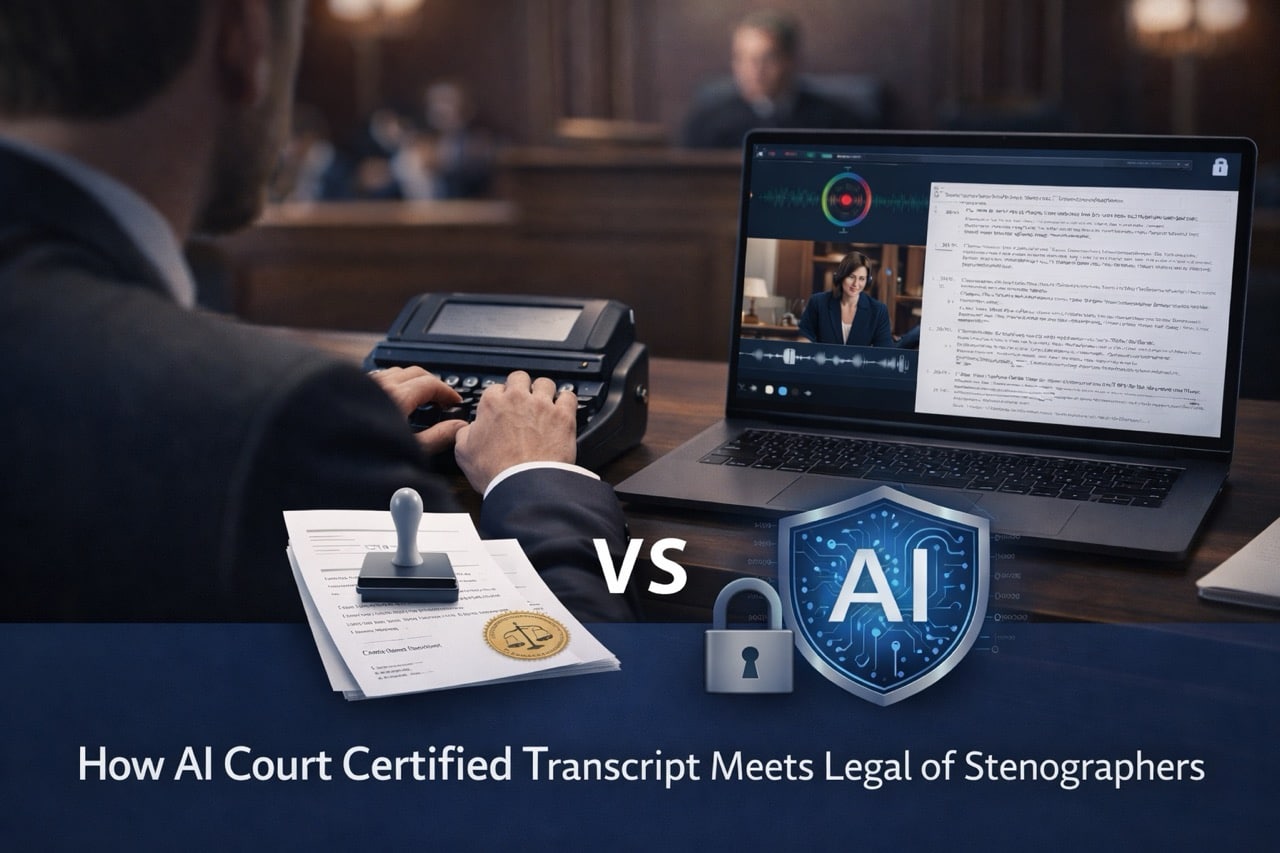
How AI Court Reporting Is Changing the Role of Stenographers
Florida attorneys worry about whether artificial intelligence threatens traditional court reporting reliability. Legal professionals see aggressive marketing for AI tools promising faster, cheaper transcription services. However, AI court reporting raises serious questions about accuracy and courtroom admissibility standards.
Courts still rely on certified professionals who maintain neutrality and accountability through sworn testimony. Technology cannot replace human judgment required for complex legal proceedings and witness credibility. Additionally, CourtScribes operates as a hybrid provider combining AI efficiency with certified expertise. The truth matters for Florida law firms making critical documentation decisions for their clients.
Why This Question Is Being Asked More Often
Law firms see more AI tools marketed as “faster” and “cheaper” alternatives to traditional services. Technology companies create confusion around whether AI can replace human stenographers completely. Florida attorneys face mounting pressure to reduce litigation costs without compromising case quality.
The rise of AI tools in legal workflows creates tempting shortcuts for busy practices. Cost reduction pressures make automated solutions appear attractive despite potential risks. However, misunderstanding exists about what courts actually require for transcript admissibility.
Many Florida attorneys don’t realize that AI court reporting alone fails legal certification standards. Professional verification remains mandatory regardless of technological capabilities or marketing claims.
What AI Can Do in Court Reporting Today
AI court reporting produces faster rough drafts that help legal teams begin case analysis. Searchable transcripts enable quick keyword location across hundreds of testimony pages efficiently. Additionally, time savings during preparation accelerate attorney workflow and case progression.
AI serves as a support tool rather than final authority for legal documentation. Technology works best with clean audio and simple dialogue between single speakers. Complex proceedings with multiple attorneys, overlapping statements, and technical terminology challenge automated systems.
Current AI capabilities provide preliminary assistance but cannot replace professional verification and certification. Florida law firms benefit from understanding realistic technology limitations before making service decisions.
Why AI Alone Cannot Replace Stenographers
Courts require certified accuracy and neutrality that only human professionals provide consistently. AI court reporting struggles with overlapping speakers who interrupt during heated exchanges. Regional accents and legal terminology confuse automated systems that lack contextual understanding.
Real-time clarification needs arise when witnesses provide unclear or contradictory testimony. Professional stenographers request immediate clarification while AI systems simply guess at meanings. Additionally, speaker identification errors attribute statements to wrong individuals throughout complex proceedings.
Florida depositions often involve multiple parties, expert witnesses, and technical discussions. These challenging environments expose AI limitations that compromise transcript reliability and courtroom acceptance.
Court Rules Still Require Human Verification
Certification requirements mandate that licensed court reporters verify transcript accuracy before court submission. Proper formatting and page-line accuracy follow specific rules that AI systems cannot implement. Chain of custody documentation requires professional attestation throughout the transcription process.
AI court reporting transcripts are not court-certified without comprehensive human review and verification. Judges rely on verified records that professional stenographers stake their licenses on. Additionally, appellate courts reject uncertified documentation lacking proper authentication and professional responsibility.
Florida courts maintain strict admissibility standards that protect legal proceeding integrity completely. Automated transcription alone fails these requirements regardless of technological sophistication.
The Hybrid Model Is the Future of Court Reporting
AI improves speed during initial transcription while humans ensure accuracy and legal admissibility. The hybrid transcription model combines technological efficiency with professional verification for optimal results. AI court reporting works best when supporting stenographers instead of attempting replacement.
Professional court reporters use AI assistance to accelerate workflow without sacrificing quality standards. Technology processes audio quickly while certified experts verify contextual accuracy and speaker identification. Additionally, hybrid approaches deliver faster turnaround than traditional methods without compromising certification.
Florida law firms benefit from AI court reporting when implemented responsibly through professional providers. This balanced approach serves client interests while maintaining courtroom compliance.
How CourtScribes Uses AI Responsibly
CourtScribes employs AI-assisted transcription combined with certified reporter review for every transcript. Our professional team verifies accuracy, corrects errors, and certifies documentation before delivery. Secure online repositories protect Florida case materials through encrypted storage and access controls.
Video-to-text synchronization links testimony moments to exact transcript locations for efficient review. AI court reporting accelerates our workflow while human expertise ensures courtroom admissibility. Additionally, certified professionals understand Florida court requirements that vary across different jurisdictions. Our hybrid model delivers speed without sacrificing the reliability Florida attorneys demand.
What This Means for Law Firms and Attorneys
Florida attorneys gain faster turnaround without risking transcript admissibility or professional credibility. Court-admissible transcripts meet judicial standards that protect case strategies and appellate options. Better trial preparation results from quick access to verified documentation.
AI court reporting benefits include:
- Reduced delays in receiving certified transcripts for motion deadlines and trial preparation
- Maintained compliance with Florida court rules and professional responsibility standards
- Improved workflow through searchable transcripts and synchronized video documentation
Technology serves Florida legal professionals when properly implemented with professional oversight.
Will AI Ever Fully Replace Stenographers?
Not under current court rules that require professional certification and accountability standards. Accuracy and certification remain essential for legal proceedings regardless of technological advances. Technology evolves rapidly but legal standards move slower to protect courtroom integrity.
Florida courts will continue requiring human verification for foreseeable future based on evidentiary rules. Professional responsibility cannot transfer to automated systems lacking licenses or accountability. Additionally, complex legal proceedings demand judgment calls that AI court reporting cannot provide. The question isn’t whether AI replaces stenographers but how technology best supports them.
Choose Accuracy Over Automation
AI supports court reporting efficiency without replacing certified professionals who ensure admissibility. Technology accelerates workflow while human expertise protects Florida cases through verified documentation. CourtScribes delivers both advantages through responsible AI court reporting implementation.
Contact CourtScribes today for hybrid transcription services that serve Florida legal professionals.
📞 Toll-Free: 833-SCRIBES
📧 scheduling@courtscribes.com
📧 billing@courtscribes.com