
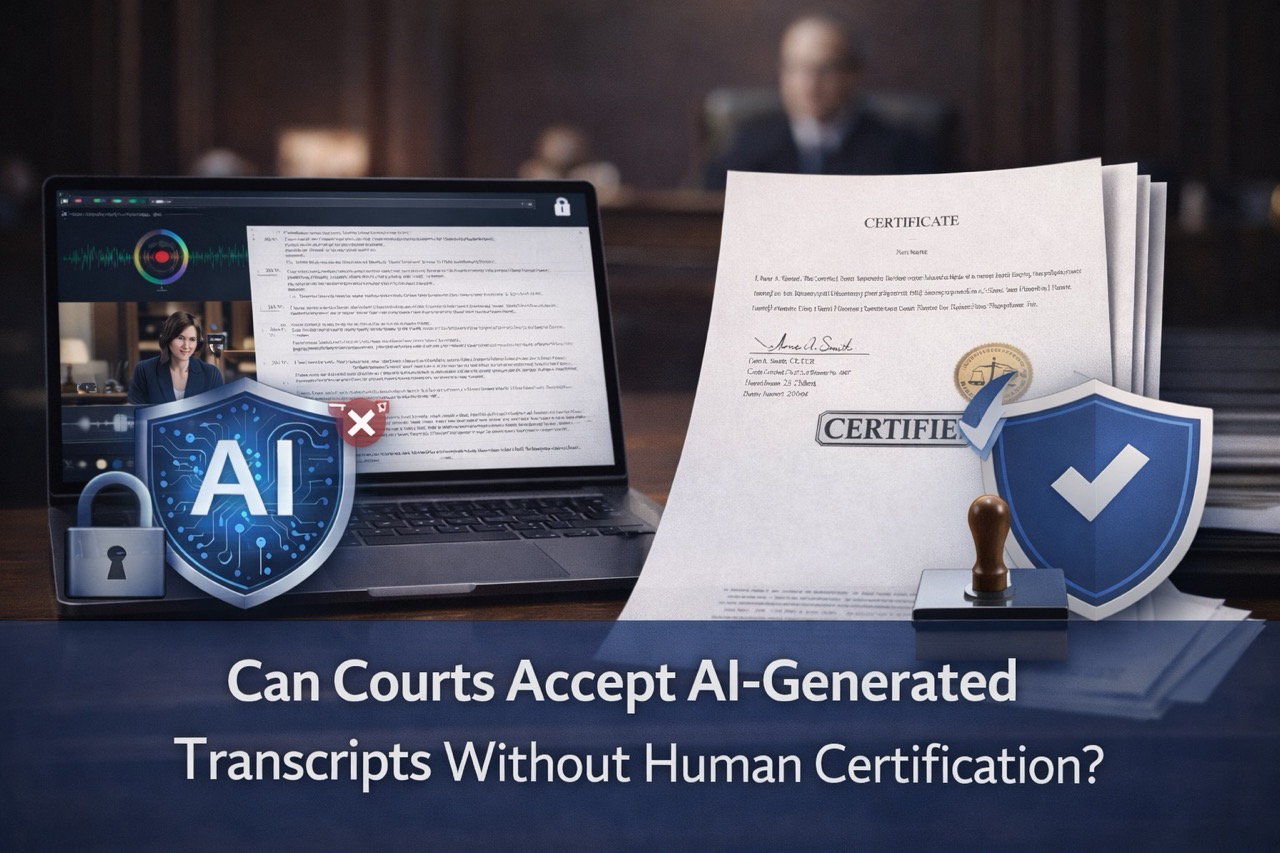
Can Courts Accept AI-Generated Transcripts Without Human Certification?
Judges across America now face a critical question that threatens case outcomes nationwide. Attorneys submit AI-generated transcripts expecting court acceptance without proper certification. However, courts increasingly reject these documents as inadmissible evidence lacking professional verification.
The issue extends beyond simple technology adoption into fundamental legal procedure requirements. Federal and state courts maintain strict admissibility standards that AI transcripts cannot meet alone. Moreover, recent rulings establish clear precedent that unverified AI documentation fails evidentiary requirements.
In this blog, you’ll learn whether AI-generated transcripts are acceptable in court and how modern evidentiary rules shape the way attorneys must handle transcript validation moving forward, helping you stay aligned with strict legal standards.
What Makes a Transcript Legally Valid?
Legal validity requires specific elements that AI systems cannot provide independently without human oversight. Courts demand certified accuracy from licensed court reporters who stake professional licenses on documentation. Additionally, proper formatting follows jurisdiction-specific rules that automated systems frequently violate.
Chain of custody documentation establishes evidence integrity from deposition through trial presentation. Professional certification creates accountability that AI providers cannot offer under current regulatory frameworks. Furthermore, neutral documentation prevents bias that algorithms might introduce through programming decisions.
Courts accept only transcripts meeting these established legal standards regardless of technological sophistication. AI transcripts lack fundamental validity elements that judges require for admissibility everywhere.
Recent Court Rulings on AI Transcript Admissibility
Several jurisdictions explicitly addressed AI transcript validity through published opinions that guide legal practice. Courts consistently rule that unverified AI transcripts fail authentication requirements under evidence rules. These decisions establish that technology alone cannot replace certified court reporter verification.
One federal district court rejected AI-generated deposition transcripts lacking professional certification entirely. The judge noted that automated systems cannot provide sworn attestation required for official records. Likewise, state appellate courts dismiss AI transcripts that lack proper human verification and certification.
These rulings create binding precedent that affects litigation strategy nationwide for attorneys. Courts prioritize testimony accuracy over technological convenience when admissibility questions arise during proceedings.
Why Courts Require Certified Human Verification
Certified court reporters provide accountability that AI systems fundamentally cannot replicate under law. Professional licenses create legal responsibility for accuracy that protects judicial integrity. Additionally, human reporters identify and clarify unclear testimony that automated systems simply guess at.
Speaker identification requires contextual judgment that technology lacks in complex multi-party proceedings. Overlapping dialogue, interruptions, and simultaneous speech confuse AI transcription algorithms consistently. Moreover, legal terminology and technical language require expertise that general AI models do not possess.
Courts depend on professional judgment that certified reporters exercise throughout documentation processes. This human element remains irreplaceable despite impressive technological advances in transcription speed and efficiency.
The Legal Risks of Using AI-Only Transcripts
Attorneys face serious professional consequences when submitting inadmissible transcripts to courts. Judges may sanction lawyers who fail to provide properly certified documentation. Furthermore, opposing counsel challenges AI transcripts aggressively to exclude favorable testimony from evidence.
Case delays occur when courts reject documentation requiring expensive re-depositions of witnesses. Lost testimony happens when witnesses become unavailable for second depositions after initial proceedings. Additionally, weakened appeals result from incomplete official records that lack proper certification.
Professional liability increases when clients suffer from inadequate documentation that fails admissibility standards. These risks far outweigh any cost savings that AI-only transcription appears to offer.
Common Misconceptions About AI Transcript Validity
Many attorneys mistakenly believe that AI transcripts become valid through attorney review alone. However, courts reject this reasoning because attorneys lack court reporter licensing and certification. The misconception creates dangerous documentation gaps that compromise case integrity unexpectedly.
Another myth suggests that combining multiple AI systems improves accuracy to acceptable levels. Nevertheless, courts focus on certification requirements rather than technological sophistication or accuracy claims. Moreover, some firms assume recording depositions provides backup that satisfies court requirements independently.
Courts distinguish between recordings and certified transcripts with different admissibility standards for each. Understanding these distinctions prevents costly mistakes that undermine litigation strategies and client interests.
Understanding the Cost-Benefit Analysis
AI transcription promises lower costs but creates hidden expenses through inadmissibility and re-deposition requirements. Initial savings disappear when courts reject documentation forcing expensive procedural corrections. In addition, professional liability insurance may not cover claims arising from inadequate transcript certification.
Proper certified court reporter services cost more initially but protect against catastrophic procedural failures. The investment ensures admissibility that supports successful case outcomes and appellate preservation. Furthermore, certified transcripts prevent challenges that waste time during critical litigation phases.
Smart attorneys recognize that documentation represents foundation-level case investment requiring professional standards. Cutting corners on transcript certification creates risks that dwarf any potential savings.
How Hybrid Models Solve the Admissibility Problem
Professional hybrid approaches combine AI efficiency with required human certification for optimal results. This integrated model addresses both speed concerns and legal admissibility requirements that attorneys face.
Here’s how responsible hybrid transcription protects your cases:
- AI processes initial audio quickly while certified court reporters verify accuracy and context throughout. Technology accelerates workflow without replacing professional verification that courts require. This combination delivers faster turnaround than traditional stenography alone provides consistently.
- Human experts catch contextual errors that automated systems miss during complex legal proceedings. Certified reporters identify speaker confusion, technical terminology issues, and testimony contradictions. Professional judgment ensures proper speaker attribution and clarification notation throughout documentation.
- Official certification meets court standards through licensed reporter attestation and signature verification. Proper formatting follows jurisdiction-specific rules that AI systems frequently violate. Chain of custody documentation establishes evidence integrity from deposition through trial presentation.
- Quality control prevents admissibility challenges through systematic review before transcript delivery. Multiple verification layers catch errors that single-pass AI transcription creates. Professional oversight eliminates documentation risks that threaten case outcomes and client interests.
Critical Elements AI Cannot Provide
Legal transcript admissibility requires specific components that current AI technology fundamentally cannot deliver.
Essential certification elements include:
- Professional licensing and accountability under state law creates legal responsibility for accuracy. Court reporters risk license suspension for negligent documentation that harms proceedings. AI providers face no comparable accountability under current regulatory frameworks.
- Sworn attestation to accuracy requires human oath that automated systems cannot provide legally. Professional certification includes personal verification that transcripts represent exact testimony. Courts rely on this sworn statement when accepting documentation as official records.
- Real-time clarification ability during proceedings prevents documentation errors before they occur. Certified reporters request immediate clarification when testimony becomes unclear or contradictory. AI systems cannot interrupt proceedings to resolve ambiguities or speaker identification confusion.
- Contextual judgment for legal proceedings requires understanding of courtroom procedure and terminology. Professional reporters recognize when testimony requires specific formatting or special documentation notation. This expertise protects transcript utility for trial preparation and appellate review.
How CourtScribes Ensures Valid Transcripts
CourtScribes employs certified court reporters who verify every AI-assisted transcript before delivery. Our hybrid approach combines technological efficiency with required professional certification that courts accept. Additionally, secure platforms protect confidential case materials throughout the transcription process completely.
Professional quality control catches errors that pure AI systems create during complex proceedings. Video-to-text synchronization provides additional verification that strengthens transcript reliability and utility. Moreover, nationwide coverage ensures consistent certification standards regardless of case location or jurisdiction.
Attorneys trust CourtScribes because we understand that validity requires more than technological capability. Our integrated model delivers speed without sacrificing the admissibility that successful litigation demands.
Protect Your Cases With Certified Transcripts
AI transcripts remain invalid without certified court reporter verification under current legal standards. Courts consistently reject unverified documentation that lacks professional certification and accountability. Furthermore, hybrid models provide the only responsible path that combines efficiency with admissibility.
Professional certification protects your cases from procedural disasters that pure AI transcription creates. Contact CourtScribes today for transcripts that courts accept without challenge or hesitation.
📞 Toll-Free: 833-SCRIBES
📧 scheduling@courtscribes.com
📧 billing@courtscribes.com