
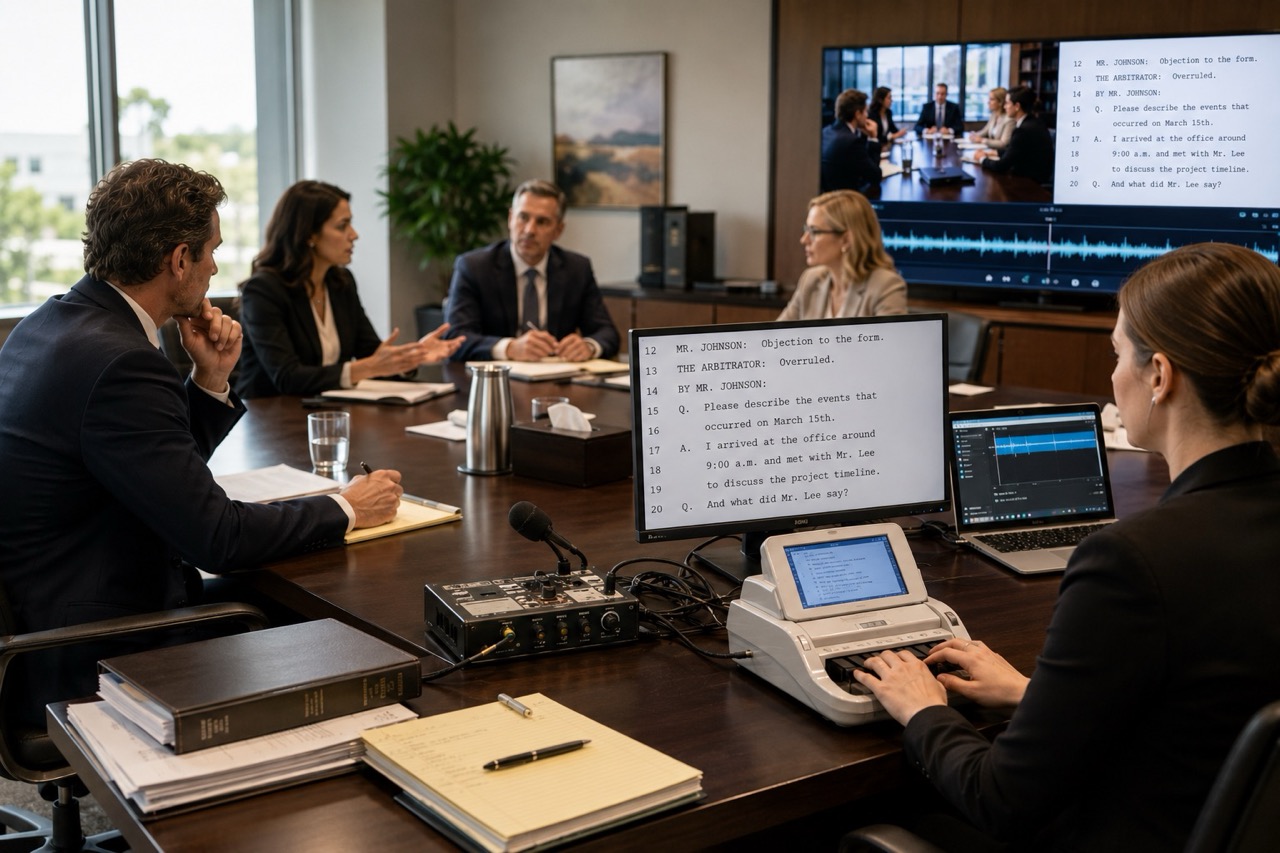
Arbitration & Mediation Reporting Services: Accurate Records for Effective Dispute Resolution
Dispute resolution outside traditional courtrooms has become increasingly common as businesses, law firms, and individuals seek faster and more flexible ways to settle conflicts. Arbitration and mediation offer efficient alternatives to litigation, but both processes require clear and accurate documentation to ensure fairness and accountability. Professional arbitration and mediation reporting services play a vital role in capturing every statement, argument, and agreement discussed during proceedings. From creating precise transcripts to supporting legal teams with reliable records, skilled court reporters help maintain clarity throughout the entire dispute resolution process while reducing the risk of misunderstandings or disputes later.
What Are Arbitration and Mediation Reporting Services?
Arbitration and mediation reporting services involve the professional recording and transcription of dispute resolution proceedings that take place outside traditional courtrooms. These services ensure that every statement, testimony, argument, and agreement discussed during arbitration or mediation sessions is accurately documented. Skilled court reporters or legal transcription professionals create verbatim transcripts that serve as reliable legal records for future reference.
In arbitration, where an arbitrator reviews evidence and makes a decision, accurate reporting is essential for maintaining a complete record of the proceedings. In mediation, where a neutral mediator helps parties negotiate a settlement, transcripts help preserve important discussions and agreements. These reporting services may also include realtime transcription, rough draft transcripts, and secure digital delivery. By providing clear and precise documentation, arbitration and mediation reporting services support legal professionals, improve transparency, and reduce the risk of disputes or misunderstandings later.
Understanding Arbitration and Mediation
Arbitration and mediation are two widely used methods of alternative dispute resolution (ADR) that help parties resolve conflicts without going through traditional courtroom litigation. While both processes aim to settle disputes efficiently and privately, they differ in structure and outcome.
Arbitration is a more formal process in which a neutral third party, known as an arbitrator, listens to both sides, reviews evidence, and delivers a decision. Depending on the agreement between the parties, this decision may be legally binding or non-binding. Arbitration is often used in business, employment, and contractual disputes because it is typically faster and more flexible than court proceedings.
Mediation, on the other hand, is less formal and focuses on negotiation. A mediator facilitates discussion between the disputing parties and helps them reach a mutually acceptable solution. Unlike an arbitrator, a mediator does not make a final decision. Instead, the goal is to encourage communication, cooperation, and voluntary agreement while preserving relationships whenever possible.
Why Accurate Reporting Matters
Accurate reporting plays a critical role in arbitration and mediation because every statement, argument, and agreement made during the proceedings can influence the final outcome. Unlike informal discussions, these dispute resolution processes often involve complex legal issues, contractual obligations, and important financial or personal interests. Even a small error or omission in documentation can lead to misunderstandings, disputes, or legal complications later.
Professional reporting ensures that all spoken words are captured precisely, creating a reliable verbatim record of the session. This record becomes valuable for attorneys, arbitrators, mediators, and clients who may need to review testimony, verify statements, or clarify disputed points. Accurate transcripts also support appeals, compliance requirements, and enforcement of settlements or arbitration awards.
In addition, detailed reporting improves transparency and fairness by providing all parties with equal access to the same information. It reduces confusion and minimizes disagreements over what was said or agreed upon during proceedings. For legal professionals, accurate transcripts help strengthen case preparation and decision-making. Ultimately, precise reporting protects the integrity of the dispute resolution process and ensures that important legal discussions are preserved with clarity and reliability.
Realtime Reporting for Arbitration and Mediation
Realtime reporting has become an increasingly valuable tool in arbitration and mediation proceedings, offering legal professionals immediate access to spoken testimony, arguments, and discussions as they happen. Unlike traditional transcription, where transcripts are delivered after the session ends, realtime court reporting uses advanced stenographic technology and specialized software to convert speech into text instantly. Participants can view live transcription on laptops, tablets, or other connected devices during the proceeding.
This technology is especially beneficial in complex disputes involving multiple parties, technical terminology, or large volumes of evidence. Attorneys, arbitrators, and mediators can follow every statement with greater precision, ensuring that no critical detail is missed. Instant access to a live transcript also allows legal teams to mark important testimony, review statements quickly, and reference earlier discussions without interrupting the flow of proceedings.
Realtime reporting improves efficiency by reducing the need for repeated clarifications or lengthy note-taking. Instead of relying solely on handwritten notes or memory, attorneys can search and review live text to identify inconsistencies, contradictions, or key admissions in real time. This can strengthen questioning strategies and improve decision-making during negotiations or hearings.
Another major advantage is enhanced collaboration among legal teams. Attorneys working remotely or in different locations can access the same live transcript simultaneously, making coordination easier during high-stakes arbitration or mediation sessions. This shared access supports faster communication and more informed strategic discussions.
For sensitive or high-value disputes, realtime reporting also increases transparency and accuracy. It creates a reliable record while helping all parties stay aligned on what has been said and agreed upon. As arbitration and mediation continue to evolve, realtime court reporting remains an essential service for improving productivity, accuracy, and overall case management.
Who Uses Arbitration and Mediation Reporting Services?
Many professionals rely on these services, including:
- Law firms
- Corporate legal departments
- Insurance companies
- Government agencies
- Mediators and arbitrators
- Human resource departments
Any organization handling formal dispute resolution can benefit from accurate reporting.
Features of a Reliable Reporting Provider
Choosing a reliable reporting provider is essential for ensuring accuracy, efficiency, and professionalism in arbitration and mediation proceedings. A trusted provider should employ certified and experienced court reporters who are skilled in legal terminology and capable of capturing every detail with precision. Accuracy is one of the most important qualities, as even minor transcription errors can affect legal outcomes.
Fast turnaround time is another key feature. Legal professionals often need transcripts quickly for case preparation, review, or decision-making. A dependable provider should offer timely delivery without compromising quality. Strong confidentiality and data security are equally important, especially when handling sensitive legal discussions and private client information.
In addition, a reliable provider should use advanced technology such as realtime reporting, secure cloud storage, and digital transcript delivery. Excellent customer support and flexible service options further ensure smooth communication and efficient case management throughout the reporting process.
Choosing the Right Arbitration Transcript Service
The quality of your arbitration transcript can impact case preparation, decision-making, and future legal proceedings. Choosing the right reporting provider helps ensure accuracy, security, and a smooth experience from start to finish. When evaluating your options, consider the following factors:
- Experience With Arbitration Proceedings: Look for providers who regularly handle arbitration and mediation matters and understand the unique requirements of alternative dispute resolution.
- Accuracy and Reliability: Accurate transcripts are essential. Even minor errors can create confusion and affect case documentation.
- Strong Reputation: Check client reviews, testimonials, and industry experience to evaluate the provider’s professionalism and service quality.
- Advanced Technology: Features such as realtime reporting, remote participation support, secure online access, and digital transcript delivery can improve efficiency.
- Data Security and Confidentiality: Choose a provider that follows strict security protocols to protect sensitive information shared during proceedings.
- Responsive Customer Support: Reliable communication and timely assistance can help prevent delays and keep proceedings running smoothly.
- Comprehensive Litigation Support: Providers that offer additional services, such as legal videography and secure document management, can make case management easier.
A trusted arbitration transcript provider does more than create a written record. They help legal teams stay organized, informed, and prepared throughout the dispute resolution process.
Frequently Asked Questions (FAQ)
1. What is arbitration reporting?
Arbitration reporting is the process of professionally recording and transcribing arbitration proceedings to create an accurate verbatim record of everything discussed during the session.
2. What does a mediation reporter do?
A mediation reporter documents discussions, negotiations, and agreements during mediation sessions, ensuring that important statements are accurately preserved for future reference.
3. Why are arbitration transcripts important?
Arbitration transcripts provide an official record of proceedings, helping attorneys, arbitrators, and clients review testimony, resolve disputes, and support legal decisions.
4. What is realtime court reporting?
Realtime court reporting uses advanced stenographic technology to convert spoken words into live text, allowing participants to view transcripts instantly during proceedings.
5. Who needs arbitration and mediation reporting services?
Law firms, corporations, insurance companies, government agencies, mediators, and arbitrators commonly use these services for accurate documentation.
6. Are arbitration proceedings confidential?
Yes, arbitration proceedings are generally private, which is why reporting providers must maintain strict confidentiality and secure transcript handling.
7. How accurate are professional arbitration transcripts?
Professional transcripts produced by certified court reporters are highly accurate because they capture legal terminology and spoken testimony with precision.
8. Can arbitration proceedings be recorded remotely?
Yes, many reporting providers offer remote court reporting and virtual transcript services for online arbitration and mediation sessions.
9. How long does it take to receive a transcript?
Turnaround time varies by provider and project complexity, but many services offer standard, expedited, or same-day delivery options.
10. How do I choose the best arbitration transcript service?
Look for a provider with experienced reporters, strong client reviews, advanced reporting technology, fast delivery, and secure data protection.
Get Accurate Arbitration and Mediation Records You Can Trust
Arbitration and mediation reporting services play a vital role in maintaining accurate and reliable records within alternative dispute resolution. From verbatim transcripts to advanced realtime court reporting, these services enhance transparency, improve legal preparation, and support informed decision-making. Accurate documentation ensures that every critical statement, argument, and agreement is preserved for future reference.
By choosing a trusted and experienced reporting provider, legal professionals can ensure every proceeding is documented with precision, efficiency, and confidentiality. This ultimately strengthens the integrity of the dispute resolution process and gives all parties greater confidence in the outcome.
Call Us
Toll Free 833-SCRIBES
Email Us
Scheduling: scheduling@courtscribes.com
Billing: billing@courtscribes.com