
Is a Court Stenographer for Deposition Legally Required?
Yes, depositions absolutely benefit from professional court stenographer services for legal protection. Sworn testimony requires accurate documentation that courts accept without challenge or authentication disputes. What happens without a certified professional? Your carefully obtained testimony might become inadmissible evidence.
Accuracy and certification matter critically in litigation because appeals depend on official records. Depositions represent sworn testimony that judges rely on during trial and appellate review. Additionally, courts require certified transcripts that AI or recordings alone cannot provide under admissibility standards.
Professional court stenographer protects your case investment through proper documentation standards. Certified court reporters create official records that withstand legal scrutiny completely.
Is a Court Stenographer Legally Required for a Deposition?
Federal Rules of Civil Procedure do not mandate court stenographer presence for all depositions. However, state-specific rules vary significantly regarding certification requirements for transcript admissibility. Most jurisdictions require professional certification when parties intend to use deposition testimony as evidence.
What makes a transcript official? Professional certification from licensed court reporters creates legal authentication that courts demand. Certification requirements ensure accuracy standards that protect judicial proceedings and party rights. Moreover, uncertified transcripts face admissibility challenges that certified documentation avoids completely.
Smart attorneys hire certified professionals because courts consistently reject inadequate documentation lacking proper verification. Legal requirements favor professional documentation that prevents procedural complications.
What Does a Court Stenographer Do During a Deposition?
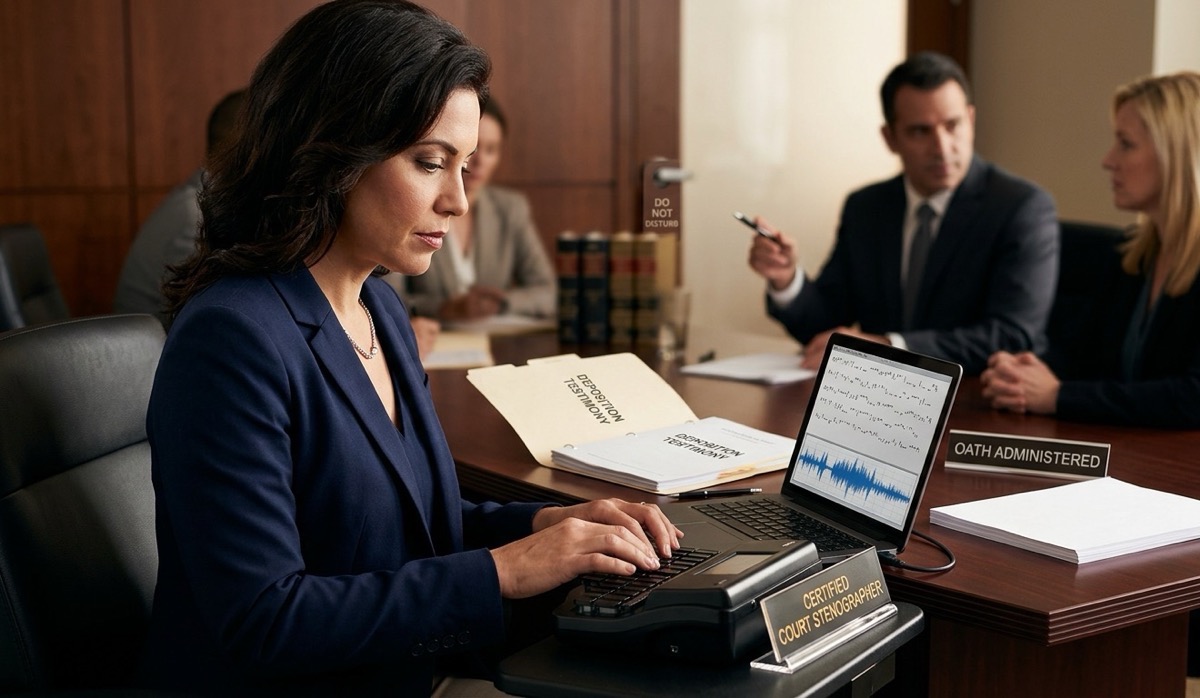
A court stenographer administers the oath that establishes legal authority for sworn testimony. They capture testimony verbatim without summarization, interpretation, or editorial changes throughout proceedings. Professional stenographers clarify unclear statements immediately by requesting speaker repetition or elaboration.
Accurate speaker identification attributes all statements to correct individuals during multi-party depositions. The stenographer produces a certified transcript that includes official attestation regarding documentation accuracy. Additionally, professional court reporters maintain neutrality while documenting sensitive testimony and confidential information.
These responsibilities require training and expertise that general transcriptionists lack under legal standards. Professional stenography protects case integrity through comprehensive documentation that supports successful litigation.
Can You Use AI or Audio Recording Instead?
Audio recordings alone are usually not admissible without certified transcription that meets court standards. Courts distinguish between raw recordings and official transcripts with different evidentiary requirements. AI transcription limitations include significant problems with overlapping speakers during heated exchanges or objections.
Regional accents and technical terminology confuse automated systems that lack contextual understanding. Legal proceedings involve specialized language that general AI models cannot process accurately. Furthermore, lack of certification prevents AI transcripts from serving as official records regardless of accuracy.
A court stenographer for deposition provides human verification that courts require for admissibility everywhere. Court-admissible transcripts need professional certification that AI systems cannot provide under current regulations.
What Happens If You Skip a Court Stenographer?
Skipping professional stenography creates serious risks that threaten case outcomes and client interests. Inadequate documentation undermines litigation strategies that depend on accurate testimony preservation. Moreover, procedural problems multiply when courts reject uncertified documentation during critical proceedings.
Here’s what happens when you skip certified court reporter services:
- Transcript disputes arise when parties disagree about testimony content without official documentation. Opposing counsel challenges uncertified transcripts aggressively to exclude unfavorable testimony from evidence consideration.
- Challenges from opposing counsel exploit documentation gaps that professional stenography prevents completely. Credibility questions emerge when courts cannot verify testimony accuracy through certified records.
- Appeals complications develop because appellate courts require official certified transcripts for reviewing proceedings. Missing or inadequate documentation prevents effective appellate advocacy that protects client interests.
- Record inconsistencies create confusion about what witnesses actually said during depositions. Different party recollections conflict without neutral professional documentation that resolves disputes definitively.
When Is a Court Stenographer Absolutely Necessary?
Certain litigation situations demand professional court stenographer services without exception or alternative options. High-stakes proceedings require documentation that withstands aggressive challenges from opposing counsel. Additionally, complex cases benefit from comprehensive professional recording that captures every nuance.
Professional stenography becomes absolutely necessary in these critical situations:
- Depositions for trial require certified transcripts that courts accept during proceedings and summary judgment motions. Trial testimony often references deposition statements that must come from official certified records.
- Expert witness testimony involves technical language and complex opinions requiring precise documentation. Professional stenographers ensure accurate capture of specialized terminology that affects case outcomes significantly.
- Federal cases follow strict procedural rules that demand professional documentation meeting specific certification standards. Federal courts scrutinize transcript authenticity more carefully than some state proceedings.
- Multi-party litigation creates speaker identification challenges that professional stenographers handle through training and experience. Complex proceedings with numerous attorneys require expert documentation management.
- Remote depositions need professional support that ensures technology reliability and proper documentation. Remote deposition services maintain quality standards despite virtual proceeding challenges.
Court Stenographer vs Digital Court Reporter: What’s the Difference?
| Aspect | Traditional Stenographer | Digital Court Reporter |
|---|---|---|
| Method | Stenotype machine with shorthand | Digital audio/video recording |
| Real-time availability | Yes, immediate transcript feed | No, processing required |
| Certification | Licensed court reporter | May vary by jurisdiction |
| Technology | Stenotype + computer | Audio equipment + AI assistance |
| Human verification | Direct professional creation | Required for certification |
| Court acceptance | Universal acceptance | Depends on certification |
Traditional stenography uses specialized machines that professionals operate with remarkable speed and accuracy. Digital court reporting employs audio recording equipment combined with AI-assisted transcription technology. However, hybrid AI-assisted reporting combines efficiency with professional verification for optimal results.
Certification requirements remain identical regardless of technology method used during proceedings. Courts focus on professional verification rather than specific documentation technology or equipment choices.
How CourtScribes Provides Reliable Deposition Reporting
CourtScribes employs certified professionals who maintain the highest accuracy standards throughout all proceedings. Our remote deposition support enables flexible testimony collection across all jurisdictions nationwide. Professional video-to-text synchronization links testimony moments to exact transcript locations for efficient review.
Secure online repository access protects confidential case materials through encrypted storage and controlled permissions. Additionally, AI-assisted technology with human verification delivers faster turnaround without sacrificing court admissibility standards.
Our comprehensive approach combines technological efficiency with professional certification that courts trust completely. CourtScribes understands that reliable deposition reporting requires both innovation and traditional professional expertise.
How to Choose the Right Court Stenographer for Your Deposition
Smart selection protects your cases through proper vetting before critical depositions begin. Ask these essential questions:
- Is the reporter certified under state law and recognized professional organizations? Verify credentials through licensing boards before engagement.
- Do they offer remote support for virtual depositions that accommodate witness scheduling and geographic limitations? Remote capabilities reduce costs significantly.
- Are transcripts court-admissible across jurisdictions where you practice regularly? Confirm certification meets your specific court requirements.
- What is turnaround time for certified transcript delivery after deposition completion? Understanding timelines helps coordinate litigation schedules.
- Is secure storage included with transcript delivery through encrypted repositories? Data protection prevents confidentiality breaches throughout proceedings.
Protect Your Testimony with Certified Professionals
Professional court stenographer services protect testimony investment through documentation that courts accept without hesitation. Certified transcripts withstand challenges that uncertified alternatives cannot survive during aggressive litigation. Nationwide coverage ensures consistent quality regardless of case location or complexity.
CourtScribes delivers reliable court stenographer services that combine efficiency with admissibility protection. Schedule early to secure certified professionals for your critical depositions today.
📞 Toll-Free: 833-SCRIBES
📧 scheduling@courtscribes.com
📧 billing@courtscribes.com